Art Deco Twin Bottle Tantalus by George Betjemann
£2,850.00
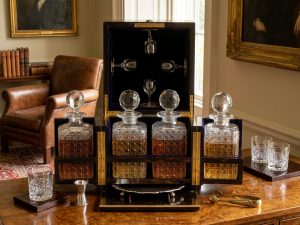
This Art Deco Twin Bottle Tantalus by George Betjemann, dating to circa 1930, is constructed with a silver plated frame housing two original blue hue cut glass decanters. Each decanter is of square section with a cut geometric design and... Read More
An Art Deco twin bottle tantalus by George Betjemann circa 1930, with silver plated frame, two original blue hue cut glass decanters and working lock with key.

| Country | |
|---|---|
| Literature | |
| Medium | |
| Period | |
| Year | |
| SKU | 501557 |

Description
Description
This Art Deco Twin Bottle Tantalus by George Betjemann, dating to circa 1930, is constructed with a silver plated frame housing two original blue hue cut glass decanters. Each decanter is of square section with a cut geometric design and fitted with a faceted glass stopper.
The frame is signed to both sides “The Tantalus”, with GB&S within an oval cartouche and “Betjemann Patent London”. The inside of the frame is further marked with the registration and model number 65957.
The original blue hue decanters make this a particularly unusual and rare version of the model, differing from the more commonly encountered clear glass examples. The tantalus is complete with its working lock and tasselled key.
View the full Tantalus Collection.
Measurements
27cm High x 26cm Wide x 12cm Deep (10.6 High x 10.24 Wide x 4.7 Deep Inches)
Literature
Mark Goodger 25th Anniversary Catalogue page 56
What is a Tantalus?
Tantalus origin traces back to the 19th century in England when a German born cabinetmaker George Betjemann patented the Tantalus model in 1881 (UK Patent 58948). Betjemann & Sons had workshops at 34-42 Pentonville Road, London from the 1830s specialising in high quality Boxes for various uses and Decanter sets including the Tantalus.
The name ‘Tantalus’ is a reference to the unsatisfied temptations of the Greek mythological character Tantalus, son of Zeus. It is told that he was trapped in Tartarus, made to stand in a pool of water beneath a fruit tree with low hanging branches. The fruit would forever elude his grasp and the pool would recede before he was able to quench his thirst. The story is in reference to the lockable aspect of the Tantalus eluding anyone trying to access the decanters without the key.
Who were George Betjemann & Sons?
George Betjemann started as an apprentice cabinet maker from a young age working for his Father in Law. In 1848, his two sons George William Betjemann and John Betjemann joined him under apprenticeships until 1846 when George William Betjemann started his own business with his two sons. In 1859 George moved to a new premises on Pentonville road, London. This was when the business became known as ‘Betjemann & Sons’. John Betjemann was grandfather of the later famous poet laureate Sir John Betjemann.
For further information see our Makers and Retailers page on George Betjemann & Sons.
What is Art Deco?
The Art Deco period was a style of visual arts, architecture, and product design that first appeared in France in the 1910s. It flourished in the United States and Europe during the 1920s to early 1930s. It was hugely prevalent through styling and design of the exterior and interior of anything from large structures to small objects and even influenced fashion and jewellery. Art Deco has influenced bridges, buildings, ships, ocean liners, trains, cars, trucks, buses, furniture, and everyday objects like radios and vacuum cleaners. It has become extremely popular today and is highly desirable to collectors and trendsetters in the fashion industry.
Why Buy from Mark Goodger Antiques?
With over thirty five years of specialist experience, Mark Goodger Antiques is recognised internationally as a leading authority in antique boxes and related works of art. Every item offered has been personally selected by Mark, whose knowledge and judgement are trusted by collectors, institutions, museums, interior designers, and fellow dealers worldwide.
Every purchase is supplied with a full supporting package for clarity and reassurance. This includes a Certificate of Authenticity, a detailed condition and care guide specific to your item, our most recent catalogue, and a separate invoice suitable for insurance and valuation purposes. Each piece is carefully examined prior to sale to ensure accuracy of description and quality.
Your purchase is fully insured during transit and protected by our straightforward money back guarantee, allowing you to buy with complete confidence. We pride ourselves on transparency, expertise, and long term relationships with our clients, many of whom return to us repeatedly over decades.
When you buy from Mark Goodger Antiques, you are purchasing from a specialist family business built on knowledge, trust, and an unrivalled focus on antique boxes.
Additional information
Additional information
| Country | |
|---|---|
| Literature | |
| Medium | |
| Period | |
| Year | |
| SKU | 501557 |