Oak Letter Box ‘Penfold’ by Thornhill
£14,950.00
Oak Carved Country House Letter Box From our Boxes Collection, we are delighted to introduce this fantastic Oak Letter Box known as the Penfold model by William Thornhill. This country house model after the original metal post boxes found in... Read More
Penfold Shaped Carved Letter Box by William Thornhill with Brass Aperture and Post Leaves Timetable

| Dimensions | 31.5 × 27 × 64 cm |
|---|---|
| Country | |
| Medium | |
| Period | |
| Literature | |
| Year | |
| SKU | 501708 |

Description
Description
Oak Carved Country House Letter Box
From our Boxes Collection, we are delighted to introduce this fantastic Oak Letter Box known as the Penfold model by William Thornhill.
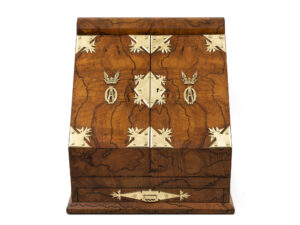
This country house model after the original metal post boxes found in every street of Victorian England is made from golden coloured Oak in a hexagonal shape with brass stringing. The top features an enamel letter aperture bordered in brass above post leaves and lock with brass escutcheon. The plinth base features a single pull out drawer with loop handle engraved by the maker W. Thornhill of 144 New Bond Street, London. Above the manufacture mark is the kite mark dating the letter box between 1868-1883. Broken down the mark reads; (II) Material – Wood, (A) Year – 1871, (W) Month – March, (30) Day – 30th, (9) – bundle number. Summarised, the post box was manufactured on the 30th of March 1871.
This identical copy of the original Penfold post box has the early letter aperture which featured on the original metal letter boxes in the top but was later changed as it was reported letters were getting jammed. Post letter boxes such as this example were used in lobbies of hotels, large country houses and country clubs for guests to post their letters. Once posted a member of staff would then collect the letters and post them onwards.
Literature The Exceptional Catalogue by Mark Goodger Antiques Page 8-9
J.W. Penfold
John Wornham Penfold (1828-1909) was an English architect and surveyor best known for designing the iconic hexagonal British post box in 1866, now referred to simply as a Penfold box. Born in Haslemere, Surrey, Penfold trained under notable architects before opening his own London practice in 1854. He held respected positions within the profession, including President of the Architectural Association School of Architecture and Honorary Secretary of the Royal Institution of Chartered Surveyors, of which he was a founding member.
Penfold’s name became forever associated with British postal heritage through his distinctive box design, identifiable by its acanthus bud finial and faceted body, now considered a staple of Victorian street architecture. His legacy even filtered into popular culture, with the character Penfold in Danger Mouse named in his honour – a nod to his association with Britain’s most recognisable post box.
Penfold Letter Boxes
The Penfold letter box, designed by architect John Penfold in 1866, is one of the most iconic early British post box designs. Recognisable by its hexagonal form and acanthus bud finial, it was produced in three sizes with nine known variations. Around 300 original boxes were made, with approximately 150 surviving today, many of which are now museum-held or listed heritage pieces.
Penfold boxes were installed not only across England and Ireland, but also exported to India, Australia, New Zealand, British Guyana and Uruguay. The Uruguayan postal service commissioned nine examples in 1879, and these versions are notable for bearing the national coat of arms rather than the usual royal cypher. New Zealand examples uniquely feature the monogram of King Edward VII, making them especially rare.
Highly collectable and widely replicated since the late 20th century, original Penfold boxes are considered a landmark in Victorian postal design and remain one of the most recognisable symbols of the British postal heritage.
Walter Thornhill
Walter Thornhill & Co. traces its roots back to 1734, when Joseph Gibbs founded the original firm as cutlers. By 1805, the business had evolved into Morley & Thornhill, and later became John James Thornhill & Co. in 1820, gaining prominence and by 1838 was listed as cutlers to the Queen. Around 1850, Walter Thornhill assumed control, and from c.1875, the company traded as Walter Thornhill & Co.
By the late 19th century, the firm was producing high-quality travelling cases, dressing sets, writing boxes, and refined luxury accessories, often in coromandel, tortoiseshell, silver, and fine veneers. In 1895, the company was incorporated as a limited liability firm, described as cutlers, gold and silversmiths, jewellers, and manufacturers of travelling bags and dressing cases. Although the company was officially wound up in 1905, trading continued under the name W. Thornhill & Co. until 1912.
Oak
Oak has many global variations. European Oak, also known as English or French Oak, is found in Europe. It is a well known and very popular wood due to its different types and strength yielding many uses. It can have a very simple clean look or a highly figured finish varying from tree to tree. European Oak can be Golden-yellow to light-brown in colour.
Brown Oak is from the United Kingdom and its name is derived from its red-brown colour which is resulted from an attack by “beef-steak” fungus. This usually give the wood an even colour, however, sometimes the wood can be streaked with a light brown giving it the name Tiger Oak. American White Oak, or White Oak, is found in North America. It is a very popular Oak used for many different functions. It can have a broad range of colour from yellow to a medium brown. American Red Oak, or Northern Red Oak, is also found in North America. It grows quicker and taller than White Oak which produces a coarser more open grain.
With every purchase from Mark Goodger Antiques, you will receive our latest catalogue, a Certificate of Authenticity, detailed care instructions for your chosen piece and an independent invoice (for insurance purposes) will be enclosed. As well as being protected by a no-hassle, money-back policy, your piece will be entirely insured during the shipping process to ensure the safety of your item.
Additional information
Additional information
| Dimensions | 31.5 × 27 × 64 cm |
|---|---|
| Country | |
| Medium | |
| Period | |
| Literature | |
| Year | |
| SKU | 501708 |