Silver Mounted Tilting Decanter Hukin & Heath
£2,400.00
Manufactured by Hukin & Heath From our Decanter collection, we are pleased to offer this Silver Mounted Tilting Decanter Hukin & Heath. The Decanter with faceted stopped fitted in the original silver plate frame with top loop handle and lockable... Read More
Sterling Silver and Silver Plate Hukin and Heath Single Bottle Tilting Decanter

| Dimensions | 13.5 × 10.5 × 37 cm |
|---|---|
| Country | |
| Medium | |
| Period | |
| Year | |
| SKU | 501661TRCE |

Description
Description
Manufactured by Hukin & Heath
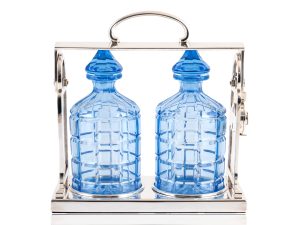
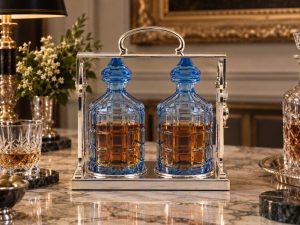
From our Decanter collection, we are pleased to offer this Silver Mounted Tilting Decanter Hukin & Heath. The Decanter with faceted stopped fitted in the original silver plate frame with top loop handle and lockable mount to the base of the decanter signed Hobbs & Co, London. The frame allows the user to pour the drink safely by tilting it down to one side without touching the bottle or contents. This would be particularly effective on a yacht which the decanter could remain unlocked swinging gently without falling over. The frame of the decanter is silver plated and marked to the base H&H (Hukin & Heath) with the logo and registration number 21390. The collar of the decanter is solid silver and hallmarked Hukin & Heath, Birmingham and dated 1912 during the Art Nouveau period.
The Tantalus comes complete with a working lock and tasselled key.
Hukin and Heath were important Silversmiths and electroplaters of Birmingham (1855-1953). Established by Jonathan Wilson Hukin and John Thomas Heath. They registered Birmingham marks in 1875 and London marks in 1879. The firm began working in conjunction with Dr. Christopher Dresser in 1877 and some of their most notable designs have Dresser influence.
Hobbs & Co was founded by Alfred Charles Hobbs (1812-1891) an American born in Boston, MS. Hobbs became a salesman for one of America’s foremost lock manufacturers named Jones & Newell in 1840. He travelled to London for the 1851 Great Exhibition and entered fame when he managed to pick both a Bramah lock and also the famous Chubb detector lock. As a result Hobbs formed a company in London which was formally registered as Hobbs & Co. The firm went through various incarnations becoming Hobbs, Ashley & Co in 1855 and then Hobbs, Ashley & Fortescue and finally Hobbs, Hart & Co in 1860 based in Cheapside in London. They were very successful using advanced machine production methods not only creating locks but exceptional furniture too. In 1860 Alfred returned to America after the death of his partner Ashley. He had never intended to stay in Britain, so was happy to sell the thriving firm on to John Mathias Hart, whilst maintaining a beneficial interest in it. He returned to England in 1872 to celebrate their 21st anniversary.
Art Nouveau was an international style of art and architecture, especially the decorative arts. It was inspired by natural forms such as the curves of plants and flowers. Other characteristics of Art Nouveau were a sense of dynamism, movement and the use of modern materials particularly iron, glass and ceramics to create unusual forms. It was popular between 1890 and 1910 during the Belle Époque period and before the First World War. It was a reaction against the academic art, eclecticism and historicism of 19th century architecture and decoration.
With every purchase from Mark Goodger Antiques, you will receive our latest catalogue, a Certificate of Authenticity, detailed care instructions for your chosen piece and an independent invoice (for insurance purposes) will be enclosed. As well as being protected by a no-hassle, money-back policy, your piece will be entirely insured during the shipping process to ensure the safety of your item.
Additional information
Additional information
| Dimensions | 13.5 × 10.5 × 37 cm |
|---|---|
| Country | |
| Medium | |
| Period | |
| Year | |
| SKU | 501661TRCE |