Rosewood
Rosewood is a collective term used for a group of richly coloured, dense hardwoods most traditionally associated with the Dalbergia genus. True rosewoods are valued for their deep brown to purplish hues, often enhanced by darker veining, high natural oil content, exceptional density, and their ability to take an extremely high polish.
Historically, the most celebrated rosewood is Brazilian Rosewood (Dalbergia nigra), also known as Bahia rosewood. Renowned for its striking appearance and distinctive sweet fragrance, it became the benchmark against which all other rosewoods were judged. Other highly regarded species include Indian Rosewood (Dalbergia latifolia), Madagascar Rosewood, Cocobolo (Dalbergia retusa), Honduran Rosewood (Dalbergia stevensonii), and several Southeast Asian species such as Dalbergia oliveri.
Not all species within the Dalbergia genus produce rosewood suitable for fine furniture, but those that do share common characteristics: high density, excellent strength, fine to medium texture, and a naturally lustrous surface. These qualities make rosewood particularly desirable for luxury furniture, cabinetry, veneers, musical instruments, turnery, and decorative objects.
Rosewood has long been associated with musical instrument making, especially for guitars, marimbas, woodwind instruments, and piano components, where its tonal stability and durability are highly prized. It has also been widely used for inlay work, chess pieces, tool handles, and high end flooring.
Due to centuries of overharvesting and high global demand, most true rosewood species are now heavily restricted. All Dalbergia species are listed under CITES trade controls, making genuine rosewood increasingly rare and valuable. As a result, many unrelated timbers are marketed under rosewood names, often prefixed with geographic descriptors. While some substitutes share visual similarities, they do not possess the same density, oil content, or long term performance as true rosewoods.
Today, authentic rosewood is primarily encountered in antique furniture, historic musical instruments, and specialist conservation work. Its presence is often a strong indicator of quality, craftsmanship, and period authenticity.
Showing 1–18 of 91 resultsSorted by latest
-


Georgian Tunbridge Ware Sewing Box
-


Rosewood Writing Box by Taulin
-


Vanity Box in Rosewood by Howell James & Co
-


Rosewood Sewing Box with Engine Turned Decoration
-


Rosewood Writing Box
-


Rosewood Sewing Box
-


Victorian Travelling Rosewood Apothecary Cabinet
-


Victorian Entertainment Humidor Compendium
-


Rosewood Karlsbad Tea Caddy
-


French Boulle Boxes Opposing Pair Napoleon III
-


Georgian Glazed Silk Embroidered Tea Caddy
-
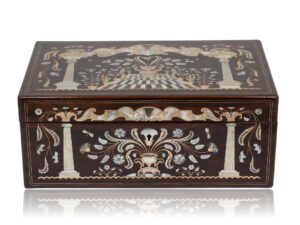

Inlaid Writing Box Hausburg
-


Tunbridge Ware Sewing Box
-


Antique Rosewood Sewing Box
-


Continental Palm Coconut Wood Box
-


French Rosewood Jewellery Box
-
 RESERVED
Antique Jewellery Box by Hausburg
-
 SOLD

Georgian Rosewood Sewing Box by Edwards