David Edwards
David Edwards was a distinguished London cabinetmaker and specialist in writing boxes and dressing cases, renowned for exceptional craftsmanship and royal patronage in the first half of the nineteenth century.
He established his business in 1813 at St James’s Street before relocating to 21 King Street, Bloomsbury, where he gained a reputation for producing some of the finest writing boxes, dressing cases and travelling cases of the period. His work soon attracted royal attention and he became Writing and Dressing Case Maker to His Majesty after the accession of King William IV, later holding a warrant under Queen Victoria.
In 1832 his nephew Thomas Edwards joined the firm and continued operations after David’s death in 1848. The firm’s output included jewellery boxes, sewing boxes, tea chests, canteen cases and the patented military travelling case, all noted for superb timbers, finely executed brass inlay, decorative mounts and ingenious secret compartments. Edwards may also have been responsible for the patented extending dining table using a lazy tongs mechanism, marked with an Edwards patent tablet and royal arms.
Thomas’s son, Thomas Jeyes Edwards, achieved further acclaim by winning a prize medal for excellence of workmanship at the Great Exhibition of 1851. The business remained prominent until its absorption into Asprey in 1858, after which Thomas Jeyes continued to work for the firm until 1872.
Showing 1–18 of 29 resultsSorted by latest
-
 SOLD

Georgian Rosewood Sewing Box by Edwards
-
 SOLD

Asprey David Edwards Rosewood Vanity Box
-
 SOLD

Rosewood Writing Box David Edwards
-
 SOLD

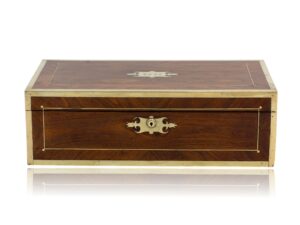
Georgian Kingwood Writing Box David Edwards
-
 SOLD

Antique Rosewood Jewellery Box Edwards
-
 SOLD

Georgian Rosewood Jewellery Box Edwards
-
 SOLD
Georgian Rosewood Jewellery Box by David Edwards
-
 SOLD

Regency Kingwood Writing Box by David Edwards
-
 SOLD
Antique Rosewood Jewellery Box by Edwards
-
 SOLD
Antique Jewellery Box by Edwards
-
 SOLD
Regency Writing Box by David Edwards
-
 SOLD
Regency Writing Box
-
 SOLD
Antique Flame Mahogany Writing Box by David Edwards
-
 SOLD
Antique Brass Bound Ladys & Gents Jewellery Box
-
 SOLD
Antique Brass Bound Writing Box with Secret Compartment
-
 SOLD
Asprey Silver Vanity Dressing Box
-
 SOLD
DAVID EDWARDS Rosewood Jewellery Box
-
 SOLD
Kingwood Sewing Box by Edwards