George Betjemann & Sons
George Betjemann and Sons were among the most important London makers of luxury dressing cases, writing boxes, travelling cases and mechanical furniture during the nineteenth and early twentieth centuries. Their work is central to the history of English cabinet making and technical innovation, and their pieces remain highly collected today.
George Betjemann was born in 1798 and apprenticed in 1810 to his uncle, the cabinet maker Gilbert Slater. After completing his apprenticeship, he married into the Merrick family of cabinet makers and later joined his father in law William Merrick in Clerkenwell. In 1834 George established his own workshop at Upper Ashby Street and soon brought his two sons, George William and John, into the trade. Both boys completed their apprenticeships by 1855, allowing the firm to expand into neighbouring premises.
In 1859 the Betjemann family moved their home and business to 36 Pentonville Road. The firm now traded as George Betjemann and Sons and quickly grew in scale and reputation. By the early 1870s they occupied 36 and 38 Pentonville Road and employed more than one hundred skilled craftsmen. By 1875 they had absorbed number 40, creating a large multi building manufactory. Their work was exhibited at the International Exhibition of 1862 and the Paris Exposition of 1867 where they presented a wide range of dressing cases, writing desks, bookslides, mechanical fittings and ornamental works in exotic materials.
The Betjemann firm became renowned for ingenious mechanical inventions. They patented improvements to dressing cases, jewel cases, games boxes and many types of fitted furniture. Their most celebrated mechanism automatically opened side trays and the front panel of a dressing case the moment the lid was lifted. This innovation was patented in 1862 and was later used by other luxury retailers including Asprey.
The company also played a foundational role in the history of the tantalus. The first known patent for a modern lockable decanter stand was registered in 1879 by John Betjemann, the son of George Betjemann. By this time the family workshops at 34 to 42 Pentonville Road were at full scale production and the firm began producing some of the finest tantalus frames and spirit stands of the Victorian period. These pieces combined mechanical ingenuity with high quality cabinet work and became a signature product of the firm.
George Betjemann died in 1886 at the age of eighty eight. His sons continued the business in partnership until the death of John in 1893. The surviving brother George William then worked with his nephews, John George Betjemann and Ernest Edward Betjemann. Around 1896 the younger generation formed a related company, Betjemann Brothers, while still working within the main family firm. Following the death of George William in 1903 both businesses were merged and in 1909 the firm became George Betjemann and Sons Ltd.
The company remained active into the early twentieth century, producing finely engineered boxes, luxurious dressing cases, clocks, writing desks and lockable spirit stands. As Ernest’s son John, later the poet Sir John Betjeman, had no wish to continue the trade, the firm was finally sold in 1939.
Today the work of George Betjemann and Sons is recognised for its exceptional use of materials, inventive design and significant influence on the development of luxury fitted cases and mechanical furniture. Their boxes and tantalus sets remain among the most desirable examples of Victorian and Edwardian cabinet making.
Showing 1–18 of 121 resultsSorted by latest
-


Victorian Coromandel Four Bottle Perfume Box
-
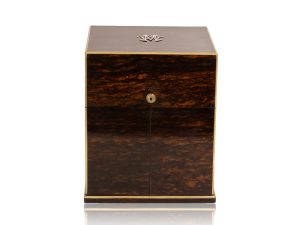
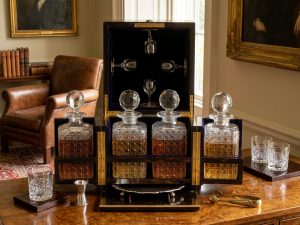
Edwardian Coromandel Decanter Box Retailed by Mappin and Webb
-
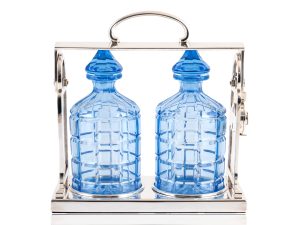
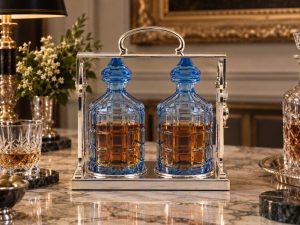
Art Deco Twin Bottle Tantalus by George Betjemann
-


Victorian Burr Walnut Decanter Box By George Betjemann
-


Coromandel Tantalus by George Betjemann
-
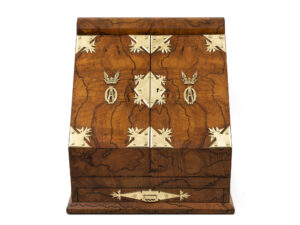

Victorian Olivewood Stationery Cabinet by Betjemann and Leuchars
-


Tantalus by George Betjemann in Calamander
-


Coromandel & Sterling Silver Writing Box Betjemann
-


Coromandel Games Compendium for King Edward VII by Betjemann
-


Partners Inkwell and Pen Stand by George Betjemann
-


Coromandel Jewellery Box by George Betjemann with Malachite
-


Tantalus by George Betjemann in Coromandel
-


Coromandel Games Compendium by George Betjemann & Chapman
-


Tantalus by George Betjemann Veneered in Coromandel and Satinwood
-


Coromandel Jewellery Cabinet Betjemann and Sons
-


Tea Caddy by George Betjemann in Coromandel and Malachite
-


Burr Walnut and Silver Mechanical Vanity Box Royal Connection
-
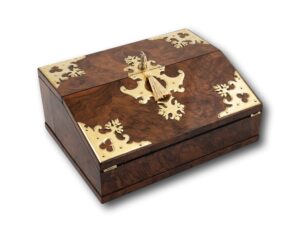
English Burr Walnut Writing Box Betjemann