John Collard Vickery
J. C. Vickery was one of Regent Street’s finest purveyors of luxury goods, renowned for high-quality jewellery, dressing cases, silverware, and refined personal accessories during the late 19th and early 20th centuries.
The firm was founded in 1890, when John Collard Vickery and his short-lived partner Arthur Thomas Hobbs acquired the long-established stationer and bookseller business of William Griggs at 183 Regent Street, London. Vickery quickly transformed the premises, expanding beyond stationery into elegant gold and silver lines, fine dressing cases, and decorative objects that attracted an affluent international clientele.
After the partnership dissolved in 1891, Vickery continued alone, rapidly elevating the business to one of Regent Street’s most respected luxury houses. In 1900, he extended the premises to include 179, 181 and 183 Regent Street, with additional showrooms at 1 New Burlington Place, marking a period of great commercial success. His reputation for excellence was recognised through numerous Royal Warrants, including those of HM the King, HM the Queen, Queen Alexandra, the Prince and Princess of Wales, and several European monarchs.
Vickery’s quality of stock reflected his refined taste. Contemporary accounts describe glamorous window displays and lavish goods, from crystal cigarette holders and enamelled watches to finely crafted boxes and jewellery. His obsession with perfection became the stuff of company legend; one well-known story recounts how he paused his carriage outside his home to pin a note to a fallen leaf asking why it had remained untouched for two days, a testament to his eye for detail.
Born in 1856 in Wiveliscombe, Somerset, Vickery began his career as a dressing case and portmanteau maker in London. His business grew steadily through the Edwardian era, but the economic pressures of the 1920s, combined with his advancing age, forced a relocation in 1925 to 145–147 Regent Street. The move, coupled with the broader financial downturn, led to the firm being declared bankrupt in 1930. Vickery died shortly after, on 19 August 1930, aged 75. What remained of the business was acquired by James Walker Ltd, who continued to retail items under the Vickery name for a time.
J. C. Vickery remains admired today for the quality of its craftsmanship and the refinement of its designs. Items bearing the Vickery mark are highly collectable, representing the elegance, innovation and luxury that defined Regent Street during its golden age.
Showing 1–18 of 27 resultsSorted by latest
-
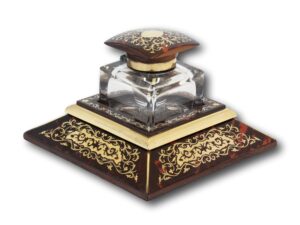

Boulle Inkwell by J. C. Vickery
-


Boulle Photo Frame by J.C. Vickery
-


Victorian Boulle Tray by J. C. Vickery
-


Victorian Boulle Stationery Box by J. C. Vickery
-


Victorian Boulle Stationery Box by J. C. Vickery and Leuchars
-


Vanity Box by Mappin & Webb in Coromandel with Sterling Silver
-
 SOLD

Victorian Boulle Blotter by J. C. Vickery
-
 SOLD

Victorian Boulle Inkwell by J. C. Vickery
-
 SOLD

Victorian Boulle Stamp Box by J. C. Vickery
-
 SOLD

Victorian Coromandel Vanity Box from the Glyn Cywarch Estate
-
 SOLD

Antique Boulle Photo Frame Vickery
-
 SOLD

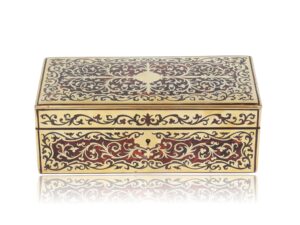
Boulle Cigar Box J. C. Vickery
-
 SOLD
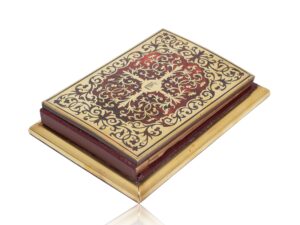
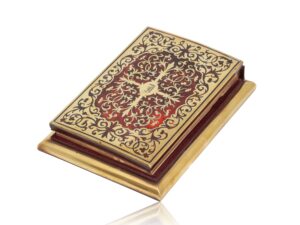
English Boulle Notebook
-
 SOLD

Victorian Boulle Trinket Box Asprey
-
 SOLD

Sterling Silver Photo Frame Clock
-
 SOLD

Asprey Brass Boulle Blotter & Note Pad
-
 SOLD

Calamander Silver Vanity Box
-
 SOLD
Antique Letter box with postal scales