Mappin & Webb
Mappin and Webb is one of the most recognised names in British silver and jewellery, with a history that reaches back to a Sheffield workshop founded in 1775.
The story begins with Jonathan Mappin, who opened a small silver workshop in Sheffield, an important centre of English silver production. Over time the business grew into Mappin Brothers. In 1860 one of Jonathan’s great grandsons, John Mappin, opened his own London business at Oxford Street. He was soon joined by his brother in law George Webb, and the firm became known as Mappin and Webb.
Their Oxford Street showroom quickly gained attention for fine silverware, candelabras and vanity items. Jewellery design followed as a natural extension of their work. By 1870 a prestigious showroom on Poultry in the City of London had been added, strengthening the company’s presence in the capital.
Expansion continued and in 1903 Mappin Brothers was acquired, bringing the business back together. New buildings and stylish showrooms were created in Oxford Street and Regent Street, designed by Belcher and Joass. By the early 20th century the Regent Street store had become the company’s flagship.
The firm encountered challenges in the 1920s, but rebuilt steadily. During the 1950s the Regent Street store was more successful than Oxford Street, and the Oxford Street showroom eventually closed in 1956. That same year the company opened a new Knightsbridge location on Brompton Road. Diversification also began, which included the acquisition of companies producing surgical instruments, cutlery, linen and other specialised goods. Several of these held Royal Warrants.
International stores were opened from the 1890s onwards, with branches appearing in Johannesburg, Buenos Aires, Rio de Janeiro, Shanghai, Hong Kong, Cairo and Bombay. The Johannesburg store, built in 1915, became a landmark, although many international stores would later close due to changes in global trade.
In 1959 Sears gained control of Mappin and Webb, and the firm acquired Garrard and Co, the Crown Jeweller. Later decades saw further corporate changes with ownership passing through Asprey, Baugur Group and eventually the Watches of Switzerland Group, where the company sits today.
Throughout its long history Mappin and Webb has served royal and distinguished clients across the world. Queen Victoria was the first British monarch to commission the firm, and the Golden Jubilee necklace created for her in 1888 is now an heirloom of the Crown. Royal Warrants have been held since 1897, and the company has created important trophies including the original Ryder Cup.
The role of Crown Jeweller has twice been held by master craftsmen from Mappin and Webb, first Martin Swift in 2012 and then Mark Appleby in 2017, demonstrating the continued trust placed in the firm for objects of national significance.
From its origins as a Sheffield workshop to its status as a leading British jeweller, Mappin and Webb remains respected for its long history, refined style and strong connection to royal and cultural traditions.
Showing 1–18 of 25 resultsSorted by latest
-
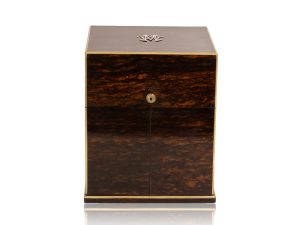
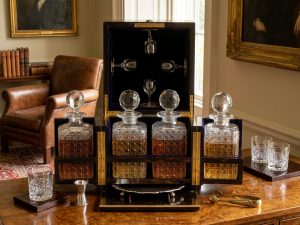
Edwardian Coromandel Decanter Box Retailed by Mappin and Webb
-


Tantalus by George Betjemann in Calamander
-


Vanity Box by Mappin & Webb in Coromandel with Sterling Silver
-
 SOLD

Calamander and Silver Tantalus by Betjemann
-
 SOLD

Cocktail Fruit Squeezer by Mappin & Webb
-
 SOLD

Decanter Box by Betjemann & Sons Retailed by Mappin & Webb
-
 SOLD

Art Deco Honey Bee Mappin & Webb
-
 SOLD

Tell Me How Art Deco Cocktail Shaker Mappin and Webb
-
 SOLD

Silver & Tortoiseshell Photo Frame Mappin & Webb
-
 SOLD
Betjemann & Son Tantalus Retailed by Mappin & Webb
-
 SOLD

Victorian Coromandel Razor Set Mappin & Webb
-
 SOLD

Art Deco Honey Bee Mappin & Webb
-
 SOLD
Silver Elizabeth II Canister Mappin and Webb
-
 SOLD

Coromandel Decanter Box Betjemann (Attributed)
-
 SOLD

Art Deco Onyx Mantel Clock
-
 SOLD
Earl & Countess Asprey Boulle Desk Set
-
 SOLD
Antique Coromandel Decanter Box
-
 SOLD
Mappin and Webb Silver Tea Caddy