William Comyns & Sons
William Comyns was an important London manufacturing silversmith whose firm operated from the mid-19th century into the mid-20th century.
The business was established in 1858, when William Comyns acquired the long-standing Soho workshop of Robert Tagg, a silversmith whose premises were associated with high-quality manufacturing work supplied to leading London retailers.
Comyns entered his first silver marks from the former Tagg premises in Soho and steadily expanded the firm through a succession of London addresses, including Percy Mews, Silver Street, Beak Street and later Marshall Street. By the 1880s the workshop had grown significantly, reflecting the firm’s increasing output of decorative silver. Around 1885, the business became William Comyns & Son when his sons, Charles Harling Comyns and Richard Harling Comyns, joined the partnership.
From the late Victorian period onward, William Comyns & Sons became especially well known for producing large quantities of decorative silver, much of it die-stamped, which was retailed through prestigious London firms including Henry Lewis and Howell & James. Their work encompassed a wide range of ornamental and functional silver objects and was valued for consistent quality and refined finish rather than experimental design.
William Comyns died in 1916, and Charles Harling Comyns died in 1925 while attending a sale at Christie’s. In 1930, the firm was incorporated as William Comyns & Sons Ltd, with Richard Harling Comyns acting as permanent governing director. Following Richard’s death in 1953, the company was acquired by Bernard Copping, under whose ownership the firm continued trading. Remarkably, William Comyns & Sons remains one of the few surviving manufacturing silversmiths in London, still operating from premises in London WC2, preserving a direct link to the city’s historic silver trade.
Showing 1–18 of 22 resultsSorted by latest
-
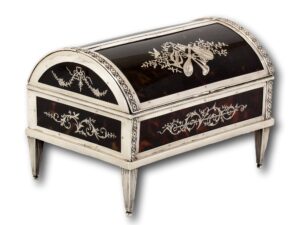

Silver and Tortoiseshell Jewellery Box by William Comyns
-


Tortoiseshell Pique Carriage Clock by William Comyns
-


Edwardian Silver & Tortoiseshell Menu Holders by William Comyns
-


Tortoiseshell & Silver Carriage Clock William Comyns
-
 SOLD

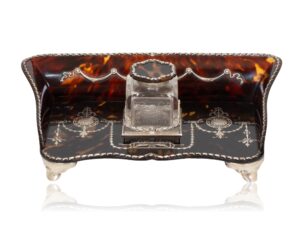
Tortoiseshell and Silver Inkwell William Comyns
-
 SOLD

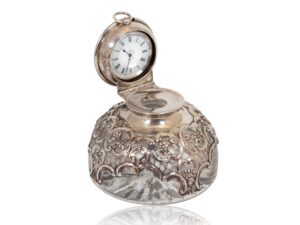
Silver Desk Inkwell Clock William Comyns
-
 SOLD
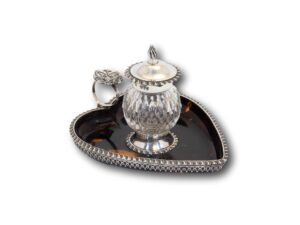
William Comyns Silver & Tortoiseshell Heart Inkwell
-
 SOLD

Victorian Silver & Tortoiseshell Set
-
 SOLD

William Comyns Candlesticks
-
 SOLD

Tortoiseshell Cased Pocket Watch Stand
-
 SOLD

Silver and Tortoiseshell Mantle Clock By William Comyns
-
 SOLD

Antique Tortoiseshell Stationery Box
-
 SOLD
Tortoiseshell Stationery Box
-
 SOLD
Tortoiseshell & Silver Tea Caddy
-
 SOLD
William Comyns Tortoiseshell and Silver Desk Set
-
 SOLD
Tortoiseshell & Silver Mantel Clock
-
 SOLD
Silver Frog Salt and Pepper Shakers
-
 SOLD
Tortoiseshell Photo Frame by William Comyns