Georgian Tea Caddy with Tea Plant Inlay
SOLD
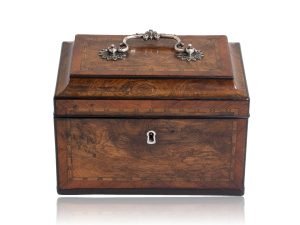
Georgian tea caddy with tea plant inlay dating to circa 1790, of octagonal form veneered in harewood and decorated with finely executed marquetry throughout. The exterior is centred by an oval cartouche depicting a blossoming tea plant, framed by a... Read More
Georgian tea caddy with tea plant marquetry, harewood veneers, tulipwood cross banding and an original floating lid, dating to circa 1790.
| Dimensions | 15 × 9.5 × 11.5 cm |
|---|---|
| Country | |
| Medium | |
| Period | |
| Year | |
| SKU | 500763 |

Description
Description
Georgian tea caddy with tea plant inlay dating to circa 1790, of octagonal form veneered in harewood and decorated with finely executed marquetry throughout. The exterior is centred by an oval cartouche depicting a blossoming tea plant, framed by a pair of inlaid Tuscan columns to each side. Matching tea plant decoration is repeated to the lid within a further oval reserve, creating a cohesive design across the caddy.
The harewood veneers are complemented by tulipwood cross banding and boxwood edging, providing a pleasing contrast to the intricate inlaid decoration. Tea plant motifs became particularly appropriate decorative features on late 18th century tea caddies, reflecting the importance and value of tea within Georgian households.
Lifting the lid reveals a fitted interior retaining traces of the original silver foil lining together with a floating lid fitted with a brass handle. The simple interior arrangement contrasts with the decorative exterior, allowing the quality of the veneers and inlay work to remain the principal focus of the piece.
The tea caddy remains complete with its working lock and tasselled key, retaining its octagonal form, tea plant marquetry and original floating lid.
View the full Tea Caddy Collection.
Mark Goodger Antiques has handled Georgian, Regency and Victorian tea caddies for decades, covering examples in tortoiseshell, pressed horn, burr woods, fruitwood, japanned surfaces, Tunbridge ware and silver. Our stock regularly includes sarcophagus forms, bombe shapes, novelty fruit caddies and rare interior configurations.
Through continued study of construction methods, veneer combinations, period inlay techniques and interior composition, we place particular emphasis on authenticity and correct attribution. Understanding which materials were used together, how interiors were finished, and how hinges and mounts were constructed is essential when assessing genuine eighteenth and nineteenth century tea caddies.
This depth of specialism allows collectors to purchase with confidence, whether acquiring a first example or adding to an established collection.
Measurements
11.5cm High x 15cm Wide x 9.5cm Deep (4.5 x 5.9 x 3.74 Inches)
What is Tulipwood?
Tulipwood is also known as Brazilian Tulipwood, Brazilian Pinkwood and Bahia Rosewood. It is found in South America, mainly Brazil. The colour is warm yellow with streaks or brown-red grain.
For further information see our Woods Encyclopaedia on Tulipwood.
What is Harewood?
Harewood is a form of sycamore maple that has been chemically treated to alter its naturally pale colour. Originally a light cream tone, the timber was stained to produce silvery grey hues which, over time, mellow into warm brown with subtle grey or green undertones.
Used extensively in seventeenth and eighteenth century marquetry, harewood was valued for its ability to take on these distinctive tones, often creating a reflective, almost metallic effect within decorative work. This made it particularly suited to fine inlaid furniture and ornamental panels.
With age and exposure, the original silvered finish deepens naturally, and surviving examples now display the richer colouring commonly seen in antique pieces today.
For further information see our Woods Encyclopaedia on Harewood.
What is Boxwood?
Boxwood known as “Buxus sempervirens” can be found in Europe, Northwest Africa and Southwest Asia. It is a light cream that turns darker to brown when exposed to light. The trees are very small meaning it is suited to smaller projects like edging or inlay instead of veneers.
For further information see our Woods Encyclopaedia on Boxwood.
What is the Georgian Era?
The Georgian era was a period in British history from 1714 to 1837, named after the Hanoverian kings George the First, George the Second, George the Third and George the Fourth. Many historians also include the short reign of William the Fourth, whose death in 1837 marks the close of the era. Within this broader period lies the Regency era, which refers to the years when George the Fourth served as Prince Regent during the illness of his father George the Third.
Why Buy from Mark Goodger Antiques?
With over thirty five years of specialist experience, Mark Goodger Antiques is recognised internationally as a leading authority in antique boxes and related works of art. Every item offered has been personally selected by Mark, whose knowledge and judgement are trusted by collectors, institutions, museums, interior designers, and fellow dealers worldwide.
Every purchase is supplied with a full supporting package for clarity and reassurance. This includes a Certificate of Authenticity, a detailed condition and care guide specific to your item, our most recent catalogue, and a separate invoice suitable for insurance and valuation purposes. Each piece is carefully examined prior to sale to ensure accuracy of description and quality.
Your purchase is fully insured during transit and protected by our straightforward money back guarantee, allowing you to buy with complete confidence. We pride ourselves on transparency, expertise, and long term relationships with our clients, many of whom return to us repeatedly over decades.
When you buy from Mark Goodger Antiques, you are purchasing from a specialist family business built on knowledge, trust, and an unrivalled focus on antique boxes.
Additional information
Additional information
| Dimensions | 15 × 9.5 × 11.5 cm |
|---|---|
| Country | |
| Medium | |
| Period | |
| Year | |
| SKU | 500763 |