Henry Clay Papier-mâché Tea Caddy
£7,500.00
Greek Revival Black-Figure Decoration From our Tea Caddy collection, we are delighted to offer this fine Henry Clay papier-mâché tea caddy dating to the Georgian period, circa 1800. The tea caddy is of oval form and constructed from papier-mâché, finished... Read More
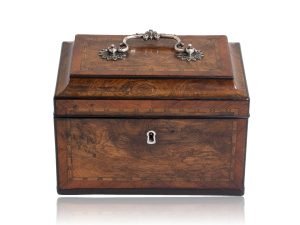
A Georgian papier-mâché tea caddy by Henry Clay, decorated in the Greek Revival black-figure style and dating to circa 1800.

| Dimensions | 12 × 8.5 × 12 cm |
|---|---|
| Country | |
| Medium | |
| Period | |
| Year | |
| SKU | 501678 |

Description
Description
Greek Revival Black-Figure Decoration
From our Tea Caddy collection, we are delighted to offer this fine Henry Clay papier-mâché tea caddy dating to the Georgian period, circa 1800.
The tea caddy is of oval form and constructed from papier-mâché, finished in a warm yellow-orange ground and decorated in the Greek Revival style inspired by ancient black-figure pottery. The exterior is framed by two black banded borders, enclosing a continuous painted frieze beneath a well modelled silver foliate loop handle. The front is adorned with a delicate snowflake escutcheon, typical of Henry Clay.
To the front and rear are silhouetted figural scenes executed in black against the yellow-orange ground. One panel depicts a classical composition described as a young nude man holding a thyrsus and flowers, opposite two young women bearing a fillet, situla, phiale and thyrsus, all rendered in the neoclassical manner characteristic of Henry Clay’s work. The painting is crisp and balanced, with strong contrast and careful detailing.
The interior is fitted with a single tea compartment faced in silver metal, retaining traces of the original silver foil lining used to preserve tea. Although unsigned, the caddy is unmistakably by Henry Clay, displaying the distinctive combination of oval form, classical painted decoration, elaborate handle and metal-lined interior associated only with his production.
This tea caddy dates to the George III period at the height of the neoclassical revival, circa 1800, and represents a refined example of early nineteenth century English papier-mâché.
Reference
The Complete Collection of Antiquities from the Cabinet of Sir William Hamilton by Pierre-François Hugues d’Hancarville Plate 121. Volume Il page 264-265
Literature
Mark Goodger Antiques The Exceptional Collection Catalogue Page 11
Henry Clay
was an assistant to one of the pioneers in papier-mache by the name of John Baskerville who started to imitate the highly polished items, that were being imported from Japan, using lacquered papier-mache. Which would become known as “japanning”. By 1772 Clay had learned enough to start up his own business and in the same year patented a new process for making “paperware” which involved sheets of paper being soaked in paste and pressed together on a plate. Once separated from the plate they were baked in a hot stove to remove any flexibility, whilst at the same time being coated in varnish or oil. The final product was used like wood, and once coated with colour and oils could be polished to a high shine. Around 1785 Henry Clay acquired a retail premise in London’s Covent Garden. George III was one of his patrons by 1792 and Clay adopted the title “Japanner to His Majesty.”
For further information see our Makers and Retailers page on Henry Clay.
Papier-mâché
is a man made material consisting of paper pieces bound with an adhesive, such as glue, starch, or wallpaper paste.
Black-figure pottery
is a style of ancient Greek ceramic decoration that was prominent from roughly 700 to 500 BCE, particularly in Athens. It is one of the most important artistic developments in ancient Greek art, especially during the Archaic period. The pottery involves the painting of figures in a black slip (a mixture of clay and water) on the natural red clay surface of a pot. During firing, the potters used a special three-step process to fix the black designs onto the surface. The Tea Caddy listed imitates this Ancient Greek style with its black-figure silhouettes and reddish-orange ground.
Why Buy from Mark Goodger Antiques?
With over thirty five years of specialist experience, Mark Goodger Antiques is recognised internationally as a leading authority in antique boxes and related works of art. Every item offered has been personally selected by Mark, whose knowledge and judgement are trusted by collectors, institutions, museums, interior designers, and fellow dealers worldwide.
Every purchase is supplied with a full supporting package for clarity and reassurance. This includes a Certificate of Authenticity, a detailed condition and care guide specific to your item, our most recent catalogue, and a separate invoice suitable for insurance and valuation purposes. Each piece is carefully examined prior to sale to ensure accuracy of description and quality.
Your purchase is fully insured during transit and protected by our straightforward money back guarantee, allowing you to buy with complete confidence. We pride ourselves on transparency, expertise, and long term relationships with our clients, many of whom return to us repeatedly over decades.
When you buy from Mark Goodger Antiques, you are purchasing from a specialist family business built on knowledge, trust, and an unrivalled focus on antique boxes.
Additional information
Additional information
| Dimensions | 12 × 8.5 × 12 cm |
|---|---|
| Country | |
| Medium | |
| Period | |
| Year | |
| SKU | 501678 |