Mauchline Ware Tea Caddy by Stiven Scotland
SOLD
A Regency period Mauchline Ware Tea Caddy by the Scottish firm Stiven dating to circa 1820. The tea caddy is of bowed square form crafted in sycamore and decorated with characteristic transfer printed panels associated with early Mauchline ware production.... Read More
A Regency period Mauchline Ware tea caddy by the Scottish maker Stiven, decorated with transfer printed panels and retaining its twin compartment interior typical of early nineteenth century tea caddies.
| Dimensions | 15.5 × 11 × 11 cm |
|---|---|
| Country | |
| Medium | |
| Period | |
| Year | |
| SKU | 501802MGE |

Description
Description
A Regency period Mauchline Ware Tea Caddy by the Scottish firm Stiven dating to circa 1820.
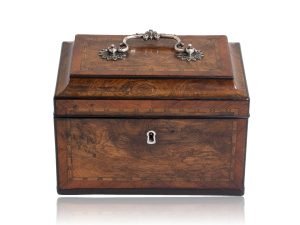
The tea caddy is of bowed square form crafted in sycamore and decorated with characteristic transfer printed panels associated with early Mauchline ware production. The side panels depict grape clusters framed within fine black pinstripe borders, while the lid features a romantic courting scene enclosed within grapevine decoration.
The exterior retains its traditional wooden hinge construction and is raised upon four turned ball feet, features commonly encountered on early nineteenth century Mauchline ware tea caddies produced during the Regency period.
Opening the caddy reveals an interior fitted with a horizontally divided twin compartment arrangement intended for the separation of teas. Traces of the original silver foil lining remain visible, reflecting the practical function of the tea caddy at a time when tea remained a valuable and carefully stored commodity within the home.
A well preserved example of a Regency Mauchline Ware Tea Caddy by Stiven combining recognised Scottish manufacture with early transfer decorated panels.
Mauchline Ware by Stiven
Stiven (J. Stiven & Sons of Laurencekirk) manufactured decorated wooden objects in Scotland during the nineteenth century. Made primarily from sycamore and finished with a hard varnish, these pieces were designed to be durable, practical and decorative. Typical forms include various boxes, needle cases, snuff boxes and other small personal items.
Decoration was applied using transfer printing, tartan patterns and scenic imagery, often depicting Scottish landmarks, literary references or patriotic motifs. Although named after the town of Mauchline in Ayrshire where the industry originated, production later spread across Scotland, with Stiven becoming one of the better known manufacturers supplying the growing tourist market. Today, Stiven Mauchline ware is recognised as a distinct category of Victorian Scottish woodenware, closely associated with nineteenth century travel, souvenir culture and domestic use.
For further information please see our Makers and Retailers page on Stiven Mauchline Ware.
Sycamore (European Sycamore)
Sycamore, also known as European sycamore or sycamore maple, is the timber of Acer pseudoplatanus, a maple species native to Europe and parts of southwestern Asia. Despite the name, it is unrelated to American sycamore and belongs firmly to the maple family.
The wood is valued for its pale, clean appearance and fine, even texture. Sycamore is typically used as sapwood, which ranges from near white to soft golden or light reddish tones. In some examples the grain can develop attractive figured effects such as curly or rippled patterning, which has long been favoured for decorative veneers and fine box work.
Sycamore has a generally straight grain, works cleanly, and takes a smooth finish, making it well suited to veneered surfaces, small boxes, musical instruments, and detailed interior items. While not suitable for damp conditions, it performs well in dry environments and has been widely used in European cabinet work for centuries.
For further information please see our Woods Encyclopaedia on Sycamore.
Regency Period
The Regency period refers to the years 1811 to 1820, when King George III was deemed unfit to rule and his son governed as Prince Regent, later King George IV. In decorative arts and furniture, the term is often used more broadly to describe the late Georgian style from around 1795 to 1837, characterised by refined proportions, classical influence, and the use of light coloured timbers, veneers, and elegant ornament derived from Greek and Roman sources.
Why Buy from Mark Goodger Antiques?
With over thirty five years of specialist experience, Mark Goodger Antiques is recognised internationally as a leading authority in antique boxes and related works of art. Every item offered has been personally selected by Mark, whose knowledge and judgement are trusted by collectors, institutions, museums, interior designers, and fellow dealers worldwide.
Every purchase is supplied with a full supporting package for clarity and reassurance. This includes a Certificate of Authenticity, a detailed condition and care guide specific to your item, our most recent catalogue, and a separate invoice suitable for insurance and valuation purposes. Each piece is carefully examined prior to sale to ensure accuracy of description and quality.
Your purchase is fully insured during transit and protected by our straightforward money back guarantee, allowing you to buy with complete confidence. We pride ourselves on transparency, expertise, and long term relationships with our clients, many of whom return to us repeatedly over decades.
When you buy from Mark Goodger Antiques, you are purchasing from a specialist family business built on knowledge, trust, and an unrivalled focus on antique boxes.
Additional information
Additional information
| Dimensions | 15.5 × 11 × 11 cm |
|---|---|
| Country | |
| Medium | |
| Period | |
| Year | |
| SKU | 501802MGE |