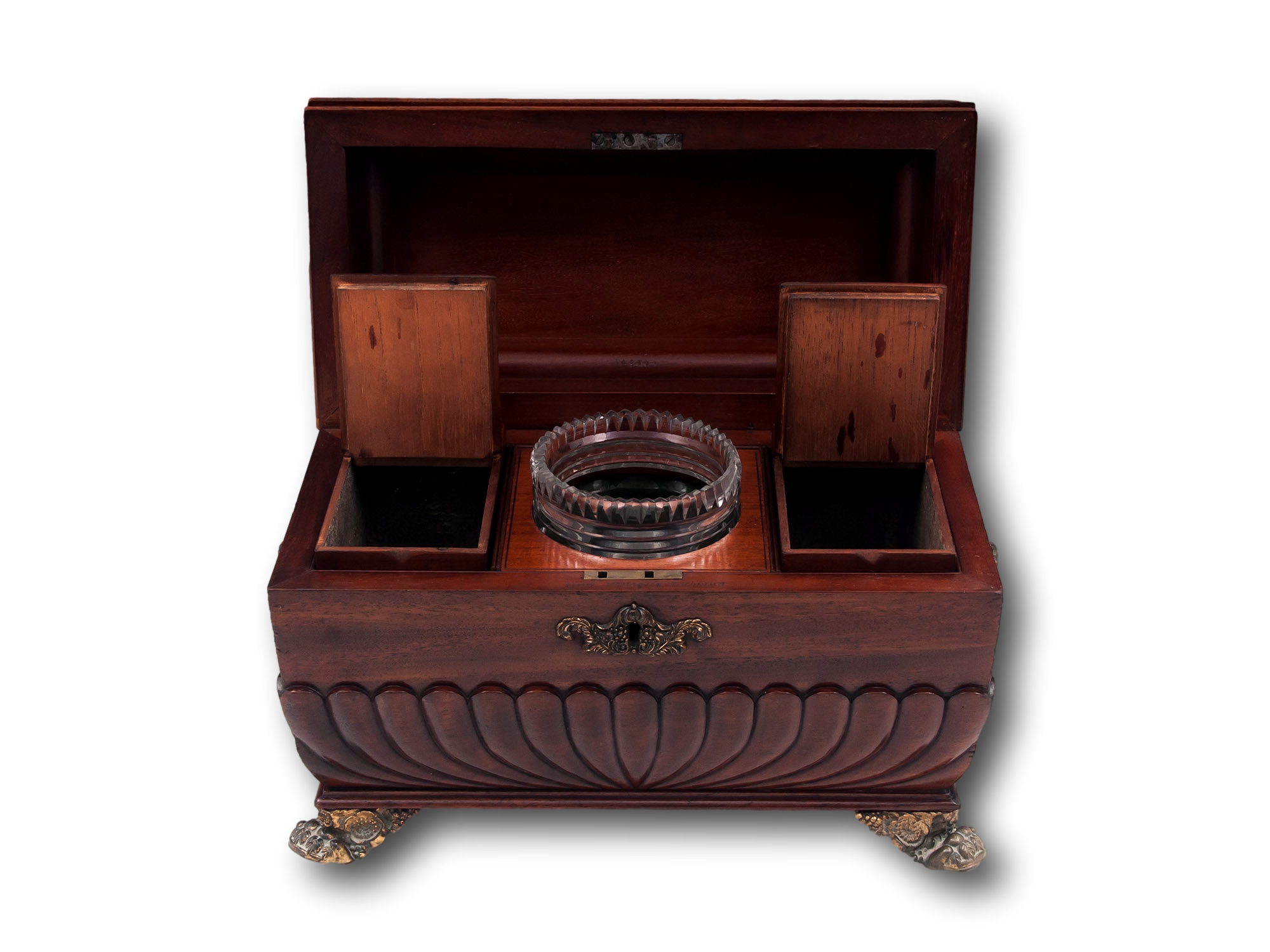


Regency Cuban Mahogany Tea Chest by Robert Wright
£2,995.00
A Regency Cuban mahogany tea chest by Robert Wright of Hull, dating to the early nineteenth century circa 1815, of sarcophagus form with an architectural pagoda top and subtly bombe shaped body raised upon four pressed gilt brass lion paw... Read More
A Regency Cuban mahogany tea chest by Robert Wright featuring twin tea caddies and a central hand cut glass sugar bowl, dating to circa 1815.

| Dimensions | 35 × 17 × 23 cm |
|---|---|
| Period | |
| Country | |
| Condition | Small antique hole filled to the rear right hand side above the hinge |
| Medium | |
| Year | |
| SKU | 500417 |

Description
Description
A Regency Cuban mahogany tea chest by Robert Wright of Hull, dating to the early nineteenth century circa 1815, of sarcophagus form with an architectural pagoda top and subtly bombe shaped body raised upon four pressed gilt brass lion paw feet.
The exterior is richly figured throughout, with the lid centred by a radiating starburst panel framed by gadrooned borders and moulded detailing surrounding the base. The front displays an ornate gilt brass scrolling escutcheon, while substantial twin loop carrying handles feature to each side, complementing the strong architectural outline of the chest.
The interior opens to reveal a fully fitted arrangement comprising a central hand cut glass sugar bowl flanked by a pair of removable tea caddies with matching hinged lids. The interior layout remains particularly well balanced, designed for the separate storage of tea and sugar within a compact yet highly functional arrangement typical of high quality Regency tea chests of the period. The hand cut sugar bowl contrasts elegantly against the warm mahogany interior, while the removable caddies retain pleasing proportions and strong colour throughout.
To the leading edge is the impressed cabinet maker’s stamp reading “R. Wright Bond Street Hull”, identifying the maker as Robert Wright, recorded within the Directory of British and Irish Furniture Makers. A particularly well executed Regency tea chest combining strong architectural form, rich Cuban mahogany veneers and finely cast gilt brass mounts. The tea chest remains complete with a working lock and tasselled key, with the fitted interior and original components surviving well for an object dating to the Regency period.
View the full Tea Caddy Collection.
Mark Goodger Antiques has handled Georgian, Regency and Victorian tea caddies for decades, covering examples in tortoiseshell, pressed horn, burr woods, fruitwood, japanned surfaces, Tunbridge ware and silver. Our stock regularly includes sarcophagus forms, bombe shapes, novelty fruit caddies and rare interior configurations.
Through continued study of construction methods, veneer combinations, period inlay techniques and interior composition, we place particular emphasis on authenticity and correct attribution. Understanding which materials were used together, how interiors were finished, and how hinges and mounts were constructed is essential when assessing genuine eighteenth and nineteenth century tea caddies.
Measurements
23cm High x 35cm Wide x 17cm Deep (9 x 13.8 x 6.7 Inches)
What is Cuban Mahogany?
Cuban Mahogany ranges from lighter pinkish brown tones to rich reddish brown, often deepening in colour with age. Prized for its strength and natural chatoyancy, the timber displays a distinctive shimmering grain and takes an exceptional polished finish. Once widely used in fine English furniture, genuine Cuban Mahogany is now increasingly scarce and highly sought after within the antiques trade.
For further information see our Woods Encyclopaedia on Cuban Mahogany.
Who was Robert Wright?
Robert Wright was a cabinet maker working in Hull during the late eighteenth and early nineteenth centuries. First recorded in the 1791 Hull directory, Wright later operated from Bond Street where he produced fine furniture and tea chests in small numbers. Due to the modest scale of his workshop, pieces bearing the Robert Wright maker’s stamp are encountered relatively infrequently today.
For further information see our Makers and Retailers profile on Robert Wright.
What is the Regency Period?
The regency period is an era of British history between 1811 and 1820. The Regency era was initiated by King George III first suffered a debilitating illness in the late 1780s. He relapsed into his mental illness in 1810 and by the Regency Act in 1811 his eldest son George, Prince of Wales, was appointed prince regent to discharge royal functions. When George III died in 1820, the Prince Regent succeeded him as George IV.
Why Buy from Mark Goodger Antiques?
With over thirty five years of specialist experience, Mark Goodger Antiques is recognised internationally as a leading authority in antique boxes and related works of art. Every item offered has been personally selected by Mark, whose knowledge and judgement are trusted by collectors, institutions, museums, interior designers, and fellow dealers worldwide.
Every purchase is supplied with a full supporting package for clarity and reassurance. This includes a Certificate of Authenticity, a detailed condition and care guide specific to your item, our most recent catalogue, and a separate invoice suitable for insurance and valuation purposes. Each piece is carefully examined prior to sale to ensure accuracy of description and quality.
Your purchase is fully insured during transit and protected by our straightforward money back guarantee, allowing you to buy with complete confidence. We pride ourselves on transparency, expertise, and long term relationships with our clients, many of whom return to us repeatedly over decades.
When you buy from Mark Goodger Antiques, you are purchasing from a specialist family business built on knowledge, trust, and an unrivalled focus on antique boxes.
Additional information
Additional information
| Dimensions | 35 × 17 × 23 cm |
|---|---|
| Period | |
| Country | |
| Condition | Small antique hole filled to the rear right hand side above the hinge |
| Medium | |
| Year | |
| SKU | 500417 |