Regency Mauchline Ware Tea Caddy with Classical Chariots
£2,750.00
This Regency Mauchline Ware Tea Caddy with Classical Chariots, dating to circa 1815, is constructed in sycamore and decorated throughout with finely detailed pen and ink transfer work. The sarcophagus shaped body is raised on four gold painted ball feet... Read More
A Regency Mauchline ware sycamore tea caddy circa 1815, attributed to Charles Stiven & Sons of Laurencekirk, with classical chariot transfers, black foliate decoration and twin internal tea compartments.

| Country | |
|---|---|
| Medium | |
| Period | |
| Year | |
| SKU | 501991TICE |

Description
Description
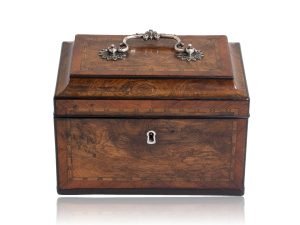
This Regency Mauchline Ware Tea Caddy with Classical Chariots, dating to circa 1815, is constructed in sycamore and decorated throughout with finely detailed pen and ink transfer work. The sarcophagus shaped body is raised on four gold painted ball feet and surmounted by a stepped pagoda style lid.
The exterior is framed by extensive black foliate scrollwork, with scrolling acanthus type decoration continuing around the front, sides and lower borders. The sloping section of the lid is further decorated with floral sprays and lyre motifs, while the top panel carries an additional classical chariot scene within a broad ornamental border.
Each principal face is centred with a different classical figure in a chariot. The front depicts Ceres or Demeter, seated beside a winged serpent or dragon and holding agricultural attributes. One side shows Minerva or Athena in armour with helmet, spear and shield, while the opposing side depicts Diana or Artemis associated with the hunt, her chariot accompanied by a stag or deer. A further classical chariot scene decorates the rear. The top of the lid depicts Juno or Hera, queen of the gods, seated in her chariot drawn by a pair of peacocks, her sacred birds and traditional symbols of royalty and pride. The delicacy of these transfer printed scenes contrasts strongly with the darker foliate borders and warm tone of the sycamore.
The caddy is firmly attributed to Charles Stiven & Sons of Laurencekirk, a workshop closely associated with finely made Scottish sycamore boxes of this type. The lid is joined using the concealed Scottish wooden hinge associated with Stiven’s production, allowing the joint to sit almost seamlessly within the timber construction.
Opening the caddy reveals a vibrant crimson lined lid above two internal tea compartments, each fitted with its original floating lid and turned wooden handle. The compartments retain their foil lining, while the working lock is accompanied by its tasselled key.
Literature
– Top Lid (Juno / Hera): Depicts the Roman queen of the gods seated in her chariot drawn by a pair of peacocks. In classical mythology, the peacock was Juno’s sacred bird, its iridescent tail feathers symbolising the eyes of Argus and representing her royal power, majesty, and pride.
– Front Panel (Ceres / Demeter): Depicts the goddess of agriculture, grain, and fertility seated in her chariot pulled by two winged serpents or dragons. Ceres holds a sheaf of wheat and floral wreaths, symbolising earth abundance, harvest, and the cycle of the seasons.
– Left Side Panel (Minerva / Athena): Depicts the goddess of wisdom, war, and useful arts clad in full armour with a crested helmet, spear, and shield. Her chariot is drawn by owls, her sacred creatures representing sharp intellect, strategic wisdom, and nocturnal foresight.
– Right Side Panel (Diana / Artemis): Depicts the virgin goddess of the hunt, wild animals, and the moon, distinguished by the crescent moon above her brow. She drives a chariot drawn by a leaping stag, symbolising purity, agility, and her dominion over nature.
– Back Panel (Chronos / Saturn): Depicts the winged deity of time seated in a chariot pulled by a coiled, winged dragon. Chronos represents the unrelenting passage of time, transformation, and cosmic order.
View the full Tea Caddy collection.
Mark Goodger Antiques has handled Georgian, Regency and Victorian tea caddies for decades, covering examples in tortoiseshell, pressed horn, burr woods, fruitwood, japanned surfaces, Tunbridge ware and silver. Our stock regularly includes sarcophagus forms, bombe shapes, novelty fruit caddies and rare interior configurations.
Through continued study of construction methods, veneer combinations, period inlay techniques and interior composition, we place particular emphasis on authenticity and correct attribution. Understanding which materials were used together, how interiors were finished, and how hinges and mounts were constructed is essential when assessing genuine eighteenth and nineteenth century tea caddies.
Measurements
16.5cm High x 24cm Wide x 13.5cm Deep (6.5 x 9.45 x 5.3 Inches)
What is Mauchline Ware?
Mauchline Ware refers to a distinctive type of Scottish woodenware produced primarily from the early 19th century until 1939. Made predominantly from sycamore, it developed from the Ayrshire souvenir trade, where small wooden objects such as snuff boxes and trinket boxes were decorated with transfer printed views of places across Scotland and beyond.
By the 1820s, Mauchline Ware was firmly established, with production centred around a small number of makers, most notably W & A Smith of Mauchline. Their output ranged from simple domestic items to more decorative boxes and tea caddies, often finished with detailed printed decoration or patterned designs.Over time, variations such as tartan ware and fernware were introduced, reflecting changes in taste and production methods. These objects were exported widely and remain highly collectable today, particularly early examples and pieces with unusual decoration.
Production ended following a fire in 1933, with the Smiths firm closing in 1939.
For further information see our Makers and Retailers profile on Charles Stiven and Sons.
What is Sycamore?
Sycamore wood also known as Harewood is a member of the Maple family, found in Europe. It is light yellow in colour and is often a very clean wood, with a straight, fine grain. The wood is often pippy. However, these pips are usually a very similar colour to the rest of the wood making them hardly visible.
For further information see our Woods Encyclopaedia on Sycamore wood.
What is the Regency Period?
The regency period is an era of British history between 1811 and 1820. The Regency era was initiated by King George III first suffered a debilitating illness in the late 1780s. He relapsed into his mental illness in 1810 and by the Regency Act in 1811 his eldest son George, Prince of Wales, was appointed prince regent to discharge royal functions. When George III died in 1820, the Prince Regent succeeded him as George IV.
What is the Georgian Era?
The Georgian era was a period in British history from 1714 to 1837, named after the Hanoverian kings George the First, George the Second, George the Third and George the Fourth. Many historians also include the short reign of William the Fourth, whose death in 1837 marks the close of the era. Within this broader period lies the Regency era, which refers to the years when George the Fourth served as Prince Regent during the illness of his father George the Third.
Why Buy from Mark Goodger Antiques?
With over thirty five years of specialist experience, Mark Goodger Antiques is recognised internationally as a leading authority in antique boxes and related works of art. Every item offered has been personally selected by Mark, whose knowledge and judgement are trusted by collectors, institutions, museums, interior designers, and fellow dealers worldwide.
Every purchase is supplied with a full supporting package for clarity and reassurance. This includes a Certificate of Authenticity, a detailed condition and care guide specific to your item, our most recent catalogue, and a separate invoice suitable for insurance and valuation purposes. Each piece is carefully examined prior to sale to ensure accuracy of description and quality.
Your purchase is fully insured during transit and protected by our straightforward money back guarantee, allowing you to buy with complete confidence. We pride ourselves on transparency, expertise, and long term relationships with our clients, many of whom return to us repeatedly over decades.
When you buy from Mark Goodger Antiques, you are purchasing from a specialist family business built on knowledge, trust, and an unrivalled focus on antique boxes.
Additional information
Additional information
| Country | |
|---|---|
| Medium | |
| Period | |
| Year | |
| SKU | 501991TICE |