Victorian Burr Walnut Decanter Box By George Betjemann
£3,900.00
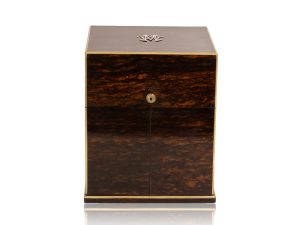
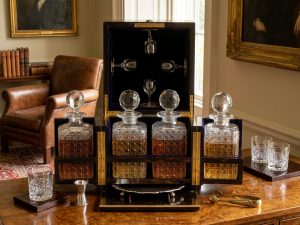
This Victorian Burr Walnut Decanter Box firmly attributed to George Betjemann and sons, dating to circa 1880, is of rectangular form with a domed lid, veneered throughout in richly figured feathered burr walnut and raised on a plinth base. The... Read More
A Victorian burr walnut decanter box by George Betjemann dating to circa 1880, with fitted decanters, glasses, Coromandel lining and engraved Durham House plaque.

| Dimensions | 38 × 24.5 × 29 cm |
|---|---|
| Medium | Brass, Coromandel, Glass, Velvet, Walnut |
| Country | |
| Year | |
| Period | |
| Literature | |
| SKU | 500964MAEE |

Description
Description
This Victorian Burr Walnut Decanter Box firmly attributed to George Betjemann and sons, dating to circa 1880, is of rectangular form with a domed lid, veneered throughout in richly figured feathered burr walnut and raised on a plinth base. The lid is inset with a brass plaque engraved Durham House within a scroll banner, while the exterior is fitted with twin flush mounted loop handles and a circular brass escutcheon to the front.
Opening the lid and twin hinged front doors reveals a deep purple interior lined in Coromandel and fitted with a complete drinks set. The arrangement comprises a gilded serving tray, two square decanters with faceted stoppers, a central circular decanter and eight glasses, including four tumblers and four spirit glasses.
A retailer’s label for Charles Henry, Manchester is fitted to the rear of the interior. Charles Henry was a known retailer of boxes produced to George Betjemann designs, supporting the attribution of this unusual example to George Betjemann & Sons of London.
The combination of form, materials and fitted drinks service is particularly unusual, and the engraved Durham House plaque suggests the box is likely to have been specially commissioned for its original owner. The decanter box retains its working Bramah lock and tasselled key.
View the full Decanter Collection.
Measurements
29cm High x 38cm Wide x 24.5cm Deep (11.4 x 15 x 9.65 Inches)
Literature
Mark Goodger 25th Anniversary Catalogue p.61
Who were George Betjemann & Sons?
George Betjemann started as an apprentice cabinet maker from a young age working for his Father in Law. In 1848, his two sons George William Betjemann and John Betjemann joined him under apprenticeships until 1846 when George William Betjemann started his own business with his two sons. In 1859 George moved to a new premises on Pentonville road, London. This was when the business became known as ‘Betjemann & Sons’. John Betjemann was grandfather of the later famous poet laureate Sir John Betjemann.
For further information see our Makers and Retailers page on George Betjemann & Sons.
What is Burr Walnut?
Burr Walnut also known as figured Walnut is a highly prized wood which is formed by a growth deformation resulting from stress, disease or nurturing the tree in a specific way. Burr can be developed by blocking the sap flow of the tree by means of putting a French Walnut on top of the roots of an American Walnut. Due to the unusual properties, it is rare to come across a Walnut tree growing this way in the wild. Nurturing planted trees takes at least 80 years before it is mature enough to be cut for good purpose. Burr Walnut is highly desired for their unusual grain and pattern, used mostly in veneering larger pieces such as furniture would be joined by matching the veneer pieces or blending them together.
For further information see our woods encyclopaedia on Burr Walnut.
What is Coromandel?
Coromandel is a valuable wood found in India, Sri Lanka and South East Asia. It has a contrasting hazel-brown colour with black grain. It is a dense, heavy wood that is so popular it has been logged to extinction over the last few hundred years. This makes Calamander pieces even more special.
For further information see our Woods Encyclopaedia on Coromandel.
What is the Victorian Period?
The Victorian period is an era of British History corresponding approximately with the reign of Queen Victoria from the 20th of June 1837 until her death on 22 January 1901 however, there are arguments stating that the Victorian era is actually from 1820 until 1914 proceeded by Georgian era and followed by the Edwardian era.
Why Buy from Mark Goodger Antiques?
With over thirty five years of specialist experience, Mark Goodger Antiques is recognised internationally as a leading authority in antique boxes and related works of art. Every item offered has been personally selected by Mark, whose knowledge and judgement are trusted by collectors, institutions, museums, interior designers, and fellow dealers worldwide.
Every purchase is supplied with a full supporting package for clarity and reassurance. This includes a Certificate of Authenticity, a detailed condition and care guide specific to your item, our most recent catalogue, and a separate invoice suitable for insurance and valuation purposes. Each piece is carefully examined prior to sale to ensure accuracy of description and quality.
Your purchase is fully insured during transit and protected by our straightforward money back guarantee, allowing you to buy with complete confidence. We pride ourselves on transparency, expertise, and long term relationships with our clients, many of whom return to us repeatedly over decades.
When you buy from Mark Goodger Antiques, you are purchasing from a specialist family business built on knowledge, trust, and an unrivalled focus on antique boxes.
Additional information
Additional information
| Dimensions | 38 × 24.5 × 29 cm |
|---|---|
| Medium | Brass, Coromandel, Glass, Velvet, Walnut |
| Country | |
| Year | |
| Period | |
| Literature | |
| SKU | 500964MAEE |