A Definitive Collector’s Guide to History, Design, Identification and Authenticity
René Lalique’s car mascots represent one of the most distinctive intersections of decorative art, engineering, and modern design to emerge during the Art Deco period. Created between 1925 and 1931, these sculptural glass radiator caps, bouchons de radiateur or hood ornaments were conceived at a moment when the motor car had become both a symbol of progress and a canvas for personal expression. For a brief but remarkable period, Lalique translated speed, power, movement, and mythology into glass, producing objects that were functional, ornamental, and deeply expressive of their time.
This guide brings together the complete history of René Lalique’s car mascots, set within the wider context of his life, his business, and the changing landscape of early twentieth-century motoring. While Lalique is best known for his jewellery, perfume bottles, and architectural glass, the radiator mascots occupy a unique place in his oeuvre. They were among the few works designed specifically to engage with motion and light in the open air, transforming the front of a motor car into a sculptural focal point.
Car mascots had emerged in the early years of motoring as personal emblems and talismans. Initially cast in metal, they soon became expressions of status and individuality. Lalique’s decision to execute these forms in glass was both daring and unconventional. Working through his firm René Lalique et Cie, he introduced a new visual language to the genre, combining naturalistic observation with bold Art Deco geometry. Although Lalique himself did not manufacture the mounts, his British agent Breves Galleries developed illuminated bases that enhanced the optical qualities of the glass, further elevating the visual impact of the mascots.
The period in which these objects were created was brief. By the early 1930s, economic conditions and changing automotive design rendered such accessories impractical, and by 1937 the category was removed from Lalique’s catalogue entirely. As a result, the car mascots exist today as finite historical artefacts, many of which survive only in small numbers. Their rarity, combined with their sculptural quality and clear authorship, has ensured their incredible appeal among collectors of Lalique, Art Deco glass, and motoring history alike.
The sections that follow provide a structured and factual overview of René Lalique’s car mascots, beginning with their historical context and continuing through individual model histories, catalogue references, signature variations, known colour variants, and practical considerations such as condition and authenticity. Image placeholders have been included throughout to allow direct visual reference to each example.
René Lalique: Personal History and Artistic Formation
René Jules Lalique was born in 1860 and spent his early childhood between Paris and the village of Aÿ. These formative years, divided between urban life and the natural landscape of the Champagne region, played a decisive role in shaping his visual language. The repeated exposure to flora, fauna, water, and movement in nature would later become central to his artistic output across jewellery, glass, and sculpture.
Following the death of his father, Lalique was apprenticed to the Parisian goldsmith Louis Aucoc, one of the most respected jewellers of the period. This apprenticeship provided rigorous technical training in traditional jewellery making while also exposing Lalique to high standards of craftsmanship and design. At the same time, it allowed him the freedom to develop an independent artistic identity that would eventually set him apart from his contemporaries.
During the 1870s and early 1880s, Lalique studied at the École des Arts Décoratifs in Paris and later at the Crystal Palace School of Art in Sydenham, London. His time in England proved especially influential, refining his graphic design skills and reinforcing his naturalistic approach to form and composition. These years of education and apprenticeship established the foundations for a career that would move fluidly between applied art, sculpture, and industrial design.
By the 1880s, Lalique was working as a freelance designer for leading Parisian jewellery houses including Cartier and Boucheron. In 1885, he established his own workshop, followed by the opening of a retail premises in the Opéra district in 1890. During this period, Lalique fundamentally challenged conventional ideas of jewellery by incorporating materials such as glass, enamel, horn, ivory, and semi-precious stones. Rather than prioritising intrinsic material value, he placed artistic expression at the centre of his work, redefining luxury through design and craftsmanship.
From Jewellery to Glass: The Lalique Business
Lalique’s increasing interest in glass became decisive in the early twentieth century. A major turning point came in 1907 with the beginning of his collaboration with François Coty, for whom he designed perfume bottles that combined sculptural artistry with industrial production. These designs transformed the perfume bottle into an integral part of the luxury object, rather than a mere container.
As demand for his glass designs grew, Lalique expanded his production capabilities. In 1922, he established a large glassworks at Wingen-sur-Moder in Alsace. This facility allowed for the controlled manufacture of both artistic and commercial glass objects at scale while maintaining high standards of quality. From this base, Lalique produced a wide range of works including lighting, architectural glass, tableware, statuettes, and decorative objects.
By the 1920s, Lalique had emerged as one of the defining figures of the Art Deco movement. His work during this period is characterised by clarity of form, stylisation, and a balance between naturalism and geometry. It was within this mature phase of his career, combining artistic confidence with industrial capability, that Lalique turned his attention to automobile accessories and car mascots.
The Rise of the Car Mascot in the Early Twentieth Century
The early decades of the twentieth century witnessed a rapid expansion of private motor ownership, particularly among wealthy and aspirational consumers. As automobiles evolved from practical machines into symbols of modernity and status, decorative elements became increasingly important.
Radiator caps and hood ornaments, originally functional components, developed into personalised statements of identity, taste, and social standing. These ornaments were typically cast in metal and often depicted animals, mythological figures, national symbols, or abstract representations of speed and power. By the early 1920s, the car mascot had become a recognised luxury accessory, especially on high-end European and American vehicles.
Within this context, the radiator mascot served both aesthetic and symbolic purposes, acting as a talisman, a marker of individuality, and a visual extension of the owner’s character and aspirations.
René Lalique and the Glass Car Mascot
René Lalique’s approach to the car mascot was both innovative and unconventional. Rather than working in metal, he chose glass as his medium, transforming the radiator ornament into a sculptural object capable of interacting dynamically with light. This decision distinguished Lalique’s mascots immediately from those of his contemporaries and aligned them closely with his broader artistic practice.
Most Lalique car mascots were produced in clear glass, with certain models also offered in opalescent, tinted and some rarer colour variations. Lalique et Cie did not manufacture metal mounting systems for these objects. Instead, the British retailer Breves of Knightsbridge commissioned illuminated mounts in two sizes, designed specifically to enhance the visual effect of the glass. Other third-party mounts were also available.
Many mascots were additionally marketed as paperweights or mounted on black glass bases as bookends. In some cases, the same model appeared simultaneously in multiple formats, reflecting both practical considerations and changing market demand.
In French, these objects were referred to as bouchons de radiateur or mascottes. In English, they are commonly known as car mascots or hood ornaments.
Catalogue of René Lalique Car Mascots 1925 to 1931
Sirène #831
Creation date 1920 Model number 831

Sirène, was created by René Lalique in 1920 and depicts a stylised mermaid with two flowing tails. The figure draws on classical mythology, where sirens were creatures whose beauty and song lured sailors to their fate. Lalique returned to the mermaid motif repeatedly throughout his career, making it one of his most recognisable symbolic forms.
Sirène was never listed by Lalique as a car mascot. However, Breves of Knightsbridge later marketed the model for use as a radiator ornament, recognising that its base dimensions were compatible with their illuminated mounts and that the subject suited automotive display.
The model was produced in clear glass and in opalescent versions and was press moulded. It appeared in the 1928, 1932, and 1937 Lalique catalogues as a statuette rather than a mascot. There are no known crystal reissues after 1947.
Signatures are found moulded to the side R. Lalique, with an engraved R. Lalique France to the base.
Naïade #832
Creation date 1920 Model number 832

Naïade, was created in 1920 and represents a water nymph holding a conch shell to her ear. In Greek mythology, naiads were freshwater nymphs associated with springs, streams, and rivers, a theme closely aligned with Lalique’s long-standing fascination with nature and mythological femininity.
Although the Naïade would physically fit Breves mounting systems, it was never officially marketed as a car mascot by either Lalique or Breves. Despite this, the model has traditionally been included in many Lalique mascot collections due to its compatible base size and suitability for automotive display.
The piece was press moulded in clear glass and opalescent versions. It appeared in the 1928, 1932, and 1937 Lalique catalogues as a statuette. No crystal reissues are known after 1947.
The model is typically signed with a moulded R. Lalique mark only.
Faucon #1124
Creation date Early August 1925 Model number 1124

The Faucon is generally regarded as the first car mascot conceived and registered by René Lalique. Depicting a standing stylised falcon, the design combines naturalistic observation with restrained Art Deco geometry. Although it carries the catalogue number 1124, it predates the Comète and Cinq Chevaux in conception.
Produced in clear press-moulded glass, the Falcon appeared in the 1928 and 1932 Lalique catalogues and was removed by 1937, though remaining stock was later sold mounted as bookends. It was titled “The Falcon” by Breves of Knightsbridge.
Signatures are moulded R. Lalique, often accompanied by the distinctive double-tailed Q.
Cinq Chevaux #1122
Creation date August 1925 Model number 1122

The Cinq Chevaux was created in reference to the Citroën 5CV automobile. Depicting five rearing horses, the design symbolised speed, power, and modernity. Breves marketed the model under the title “The Horses.” It appeared in the 1928 and 1932 catalogues and was removed by 1937. Clear press-moulded glass examples are standard.
Signatures include moulded R. Lalique with wheel-cut France.
Comète #1123
Creation date August 1925 Model number 1123

The Comète was inspired by the spectacular 1925 illumination of the Eiffel Tower for Citroën, featuring shooting stars and celestial imagery formed from thousands of light bulbs. Lalique translated this moment into glass, creating a fragile yet dynamic form intended solely for use as a radiator mascot.
The Comète could not stand independently and required a dedicated mount. It appeared in the 1928 and 1932 catalogues and was withdrawn before 1937. It is among the rarer Lalique mascots.
Signatures are moulded and wheel-cut R. Lalique France, with evidence suggesting moulded signatures were earlier in production.
Archer #1126
Creation date August 1926 Model number 1126

The Archer, representing a muscular figure aiming a bow into the airstream, was the only mascot created by Lalique in 1926. Inspired by classical depictions of Hercules, the model combines strength and tension with the inherent fragility of glass. It appeared in the 1928 and 1932 catalogues and was later offered as a paperweight.
Signatures are moulded R. Lalique and/or wheel cut.
Coq Nain #1135
Creation date February 1928 Model number 1135

The Coq Nain is a compact and highly stylised rooster, inspired in part by Japanese design sensibilities while retaining strong French symbolism. The reduced scale and simplified form distinguish it from Lalique’s other rooster designs.
Produced in clear glass and topaz tinted glass, the model appeared in the 1928 and 1932 catalogues. It was withdrawn by 1937 but continued as a paperweight and later appeared in post-war crystal reissues.
Signatures are moulded R Lalique France, with and without the double tail Q.
Tête de Bélier #1136
Creation date February 1928 Model number 1136

The ram’s head was interpreted by Lalique with bold, confident lines that emphasise strength, determination, and forward momentum. The simplified form aligns closely with the Art Deco aesthetic while retaining symbolic associations with the zodiac sign Aries, Lalique’s own astrological sign.
Produced in clear press-moulded glass, the model appeared in the 1928 and 1932 catalogues. It was removed from the Lalique catalogue in 1937 but continued to be sold mounted as bookends.
Signatures are moulded R, Lalique with France, with the double tail Q.
Tête de Coq #1137
Creation date February 1928 Model number 1137

The rooster’s head, an enduring emblem of France, was rendered by Lalique with a proud expression and assertive stance. The design balances realism with stylisation, making it well suited to both automotive display and desk use.
The model appeared in the 1928 and 1932 catalogues and was withdrawn by 1937. It continued in production as a paperweight and later appeared in crystal reissues after the war.
The original examples are moulded Lalique France, notably without the R prefix, which is correct for this pre-1945 production.
Tête d’Aigle #1138
Creation date March 1928 Model number 1138

The eagle’s head was rendered by Lalique with authority and restraint, combining expressive detail with strong geometric structure. Eagles were widely used as automotive mascots, and Lalique’s version became one of the most recognisable.
The model appeared in the 1928 and 1932 catalogues and was withdrawn in 1937, continuing as a paperweight thereafter. It was later reissued in crystal and closely copied by the Persons-Majestic Company in the United States.
Signatures are moulded R. Lalique France.
Tête d’Épervier #1139
Creation date January 1928 Model number 1139

René Lalique’s Tête d’Épervier presents a stylised hawk’s head, combining sharp Art Deco geometry with a restrained naturalism. The design is notable for its strong frontal symmetry and simplified planes, reflecting contemporary interest in Egyptian and archaic forms.
Examples are known in clear glass, opalescent glass, and topaz tinted glass. The model appeared in the 1928 and 1932 Lalique catalogues and was withdrawn by 1937. It was also marketed as a paperweight. This was one of the least expensive mascots in the range at the time of issue.
Signatures are moulded Lalique France, accompanied by the double tail Q mark. Lalique without the R. is correct for this model.
Tête de Paon #1140
Creation date February 1928 Model number 1140

The peacock head is among the most celebrated Lalique mascots, capturing the regal presence of the bird through finely modelled detail and balanced proportions. Lalique had used the peacock motif extensively in his earlier jewellery, and here translated it into a pure Art Deco form.
Examples exist in clear glass and blue glass. Opalescent versions are noted in literature but are not actually known to exist. The model appeared in the 1928 and 1932 catalogues and was removed in 1937, though it continued as both bookends and paperweights.
Signatures are moulded R. Lalique France.
Lévrier #1141
Creation date March 1928 Model number 1141
The greyhound mascot embodies speed, elegance, and aristocratic refinement. The streamlined form, pinned ears, and elongated silhouette are hallmarks of the Art Deco style and made this a popular choice for luxury automobiles of the period.
The model appeared in the 1928 and 1932 catalogues and was withdrawn in 1937. It was also offered as a paperweight. A unique non-commercial greyhound was later created for Prince George, Duke of Kent known as Lévrier 1, there are believed to be two of this model with only one ever come to market.
Signatures are moulded R. Lalique France.
Saint Christophe #1142
Creation date March 1928 Model number 1142

Saint Christopher, the patron saint of travellers, was a logical and symbolic choice for a car mascot. Lalique’s interpretation contrasts the aged saint with the youthful Christ child, whose radiating halo becomes particularly striking when illuminated.
The model appeared in the 1928 and 1932 catalogues and was removed in 1937, though it continued as a paperweight. It was later reissued in crystal in 1951.
Signatures are moulded R Lalique France.
Hirondelle #1143
Creation date February 1928 Model number 1143
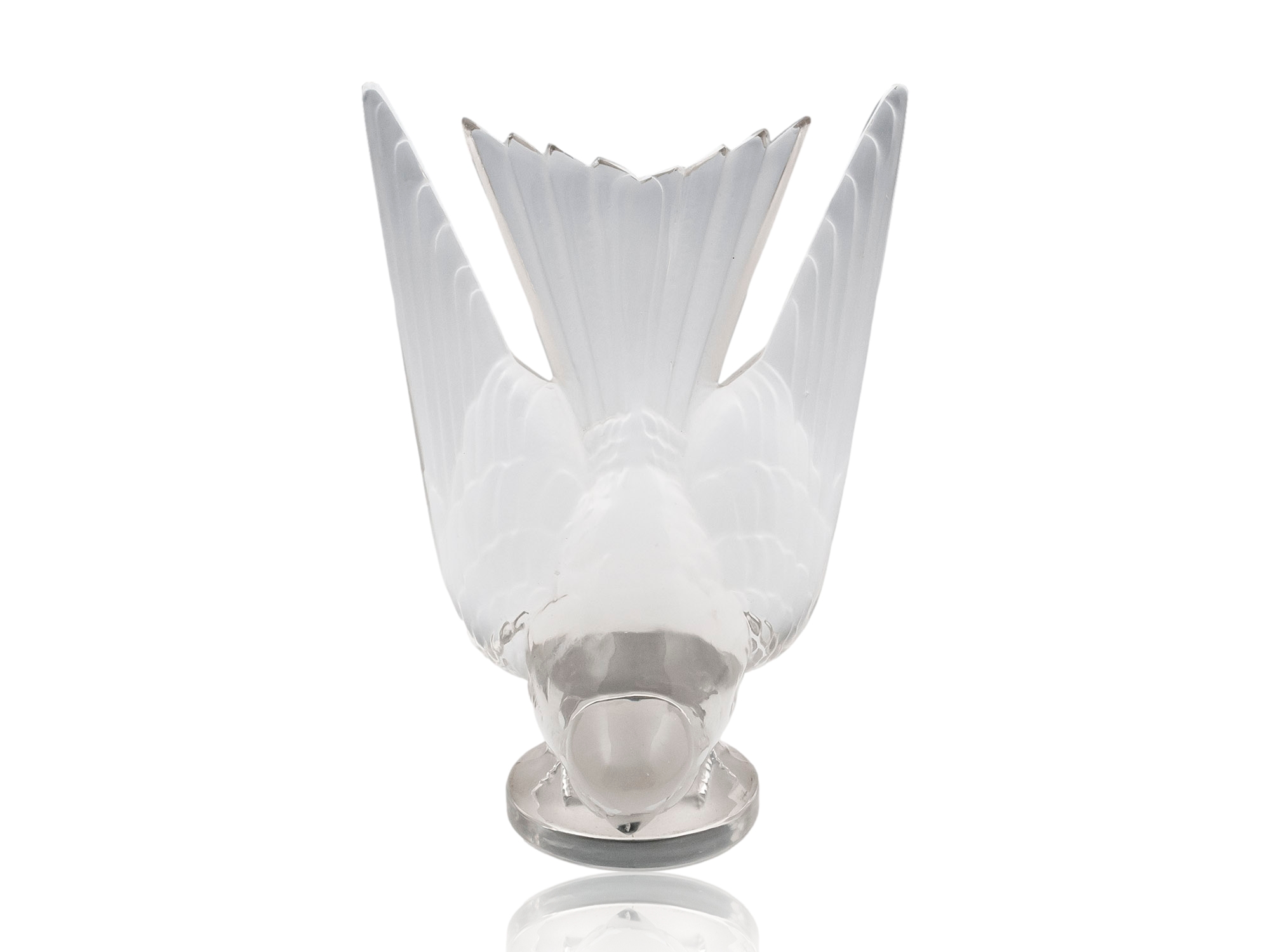
The swallow in flight was a recurring motif in Lalique’s work, symbolising freedom and speed. This mascot presents the bird in dynamic motion, appearing naturalistic from the side and distinctly Art Deco when viewed head-on.
The model appeared in the 1928 and 1932 catalogues and was withdrawn in 1937. It continued as bookends and paperweights, and later crystal versions were produced with altered bases not intended for mascot mounting.
Signatures are moulded R. Lalique France.
Petite Libellule #1144
Creation date April 1928 Model number 1144

The small dragonfly with closed wings revisits one of Lalique’s most iconic Art Nouveau motifs, reinterpreted for the Art Deco era. The compact form and delicate surface detailing make it both restrained and elegant.
The model appeared in the 1928 and 1932 catalogues and was withdrawn in 1937. No post-war crystal reissue is known.
Signatures are moulded Lalique France, without the R prefix, which is correct for this model.
Grande Libellule #1145
Creation date May 1928 Model number 1145

The large dragonfly with open wings is one of the most visually striking Lalique mascots, particularly when illuminated. The veined wings and poised stance emphasise movement and light.
The model appeared in the 1932 catalogue and was withdrawn in 1937, though it continued as a paperweight. It was later reissued in crystal in the early 21st century.
Signatures are moulded R. Lalique France, accompanied by an engraved R. Lalique France to the tail.
Grenouille #1146
Creation date May 1928 Model number 1146

The frog mascot is a playful and unconventional choice, rendered with humour and strong character. Though small, it exhibits confident modelling and was among the least expensive mascots when first sold.
The model appeared in the 1932 catalogue and was withdrawn by 1937, though it continued as a paperweight. Clear glass examples are known, with rare amethyst tinted examples also recorded. Signatures are engraved R Lalique France.
Victoire #1147
Creation date April 1928 Model number 1147
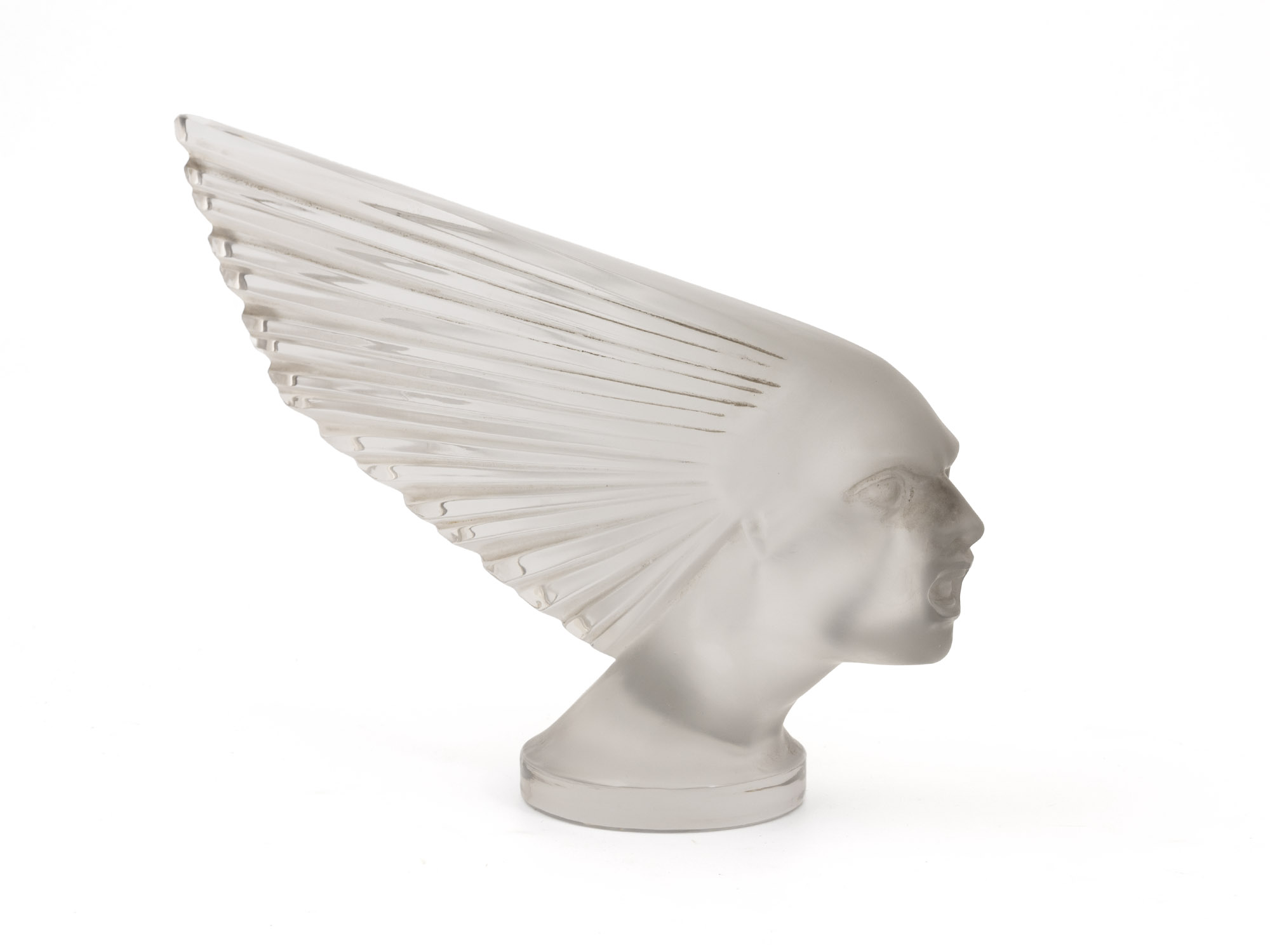
Victoire, also known as Spirit of the Wind, is the most iconic of all Lalique car mascots. The flowing hair and forward thrust epitomise the Art Deco celebration of speed, progress, and modernity.
The model appeared in the 1932 catalogue and was withdrawn in 1937. It has been widely copied and later reissued in crystal by Lalique, easily distinguished from the original pre-1945 versions.
Signatures are moulded R. Lalique France with the double tail Q.
Longchamp A #1152A
Creation date June 1929 Model number 1152A

The first version of Longchamp features a horse’s head with a flowing double mane. Inspired by classical Greek sculpture and named after the Paris racecourse, the design evokes restrained power and aristocratic control. This version was quickly superseded by the later single-mane version and is now considerably rarer.
It appeared in the 1932 catalogue and was withdrawn by 1937. The model was also sold as bookends.
Signatures are moulded R. Lalique France.
Longchamp B #1152B
Creation date September 1929 Model number 1152B

The definitive Longchamp design simplified the mane into a single flowing form, improving ease of manufacture and mounting. A subtle halter motif restrains the horse, contrasting with the unbridled energy of the Epsom model.
The model appeared in the 1932 catalogue and was withdrawn in 1937, though it continued as a paperweight. Later crystal reissues exist and are easily distinguished from originals.
Signatures are moulded R. Lalique and France.
Epsom #1153
Creation date June 1929 Model number 1153

Inspired by the Epsom Derby in England, this design captures a horse at full stretch, straining forward as if crossing the finishing line. The composition conveys speed and tension more dramatically than any other equine mascot by Lalique.
The model appeared in the 1932 catalogue and was withdrawn by 1937, though it was offered as bookends. It could not stand freely and required a dedicated mount.
Signatures are moulded R. Lalique and France.
Sanglier #1157
Creation date October 1929 Model number 1157

The wild boar reflects Lalique’s naturalist inspiration and is believed to reference the forests around Wingen-sur-Moder, where Lalique established his glassworks. The form balances strength with restraint through flattened planes and impressionistic modelling. Examples exist in clear glass and topaz (fume) tinted glass.
The model appeared in the 1932 catalogue and was withdrawn by 1937, though it continued as a paperweight. It was later reissued in crystal.
Signatures are moulded R. Lalique and stencilled R Lalique France.
Perche #1158
Creation date April 1929 Model number 1158
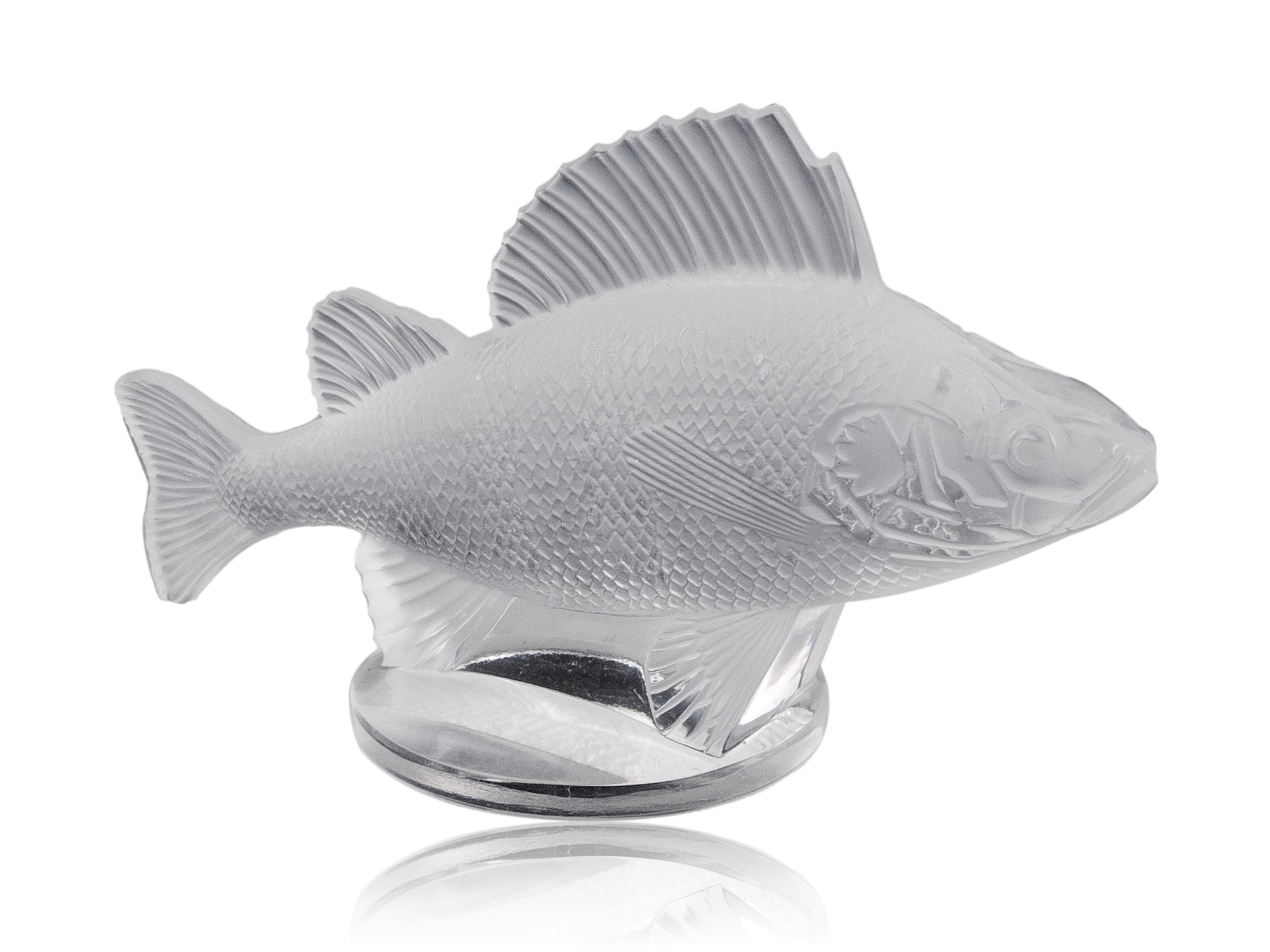
The Perche depicts a fish shown side-on, taut and purposeful, in contrast to Lalique’s earlier overhead swimming fish designs. Inspired by Lalique’s childhood walks along the River Marne at Aÿ, the form reflects calm movement and balance, qualities often associated with fish symbolism. Produced in clear glass, opalescent glass, and amber tinted examples.
The model appeared in the 1932 Lalique catalogue and was removed by 1937, though it continued as a paperweight. Breves of Knightsbridge listed the model as Fish and uniquely provided separate pricing for coloured examples.
Signatures are moulded R. Lalique and France and, on some coloured examples, wheel cut.
Vitesse #1160
Creation date September 1929 Model number 1160

Vitesse is one of Lalique’s most expressive and sensual designs, often interpreted as a celebration of speed itself. The flowing female form leans forward into the air, making it especially striking when illuminated. Produced in clear glass and opalescent glass.
The model appeared in the 1932 catalogue and was withdrawn by 1937, continuing as a statuette. Modern crystal reissues exist.
Signatures are moulded R. Lalique and France with the double tail Q.
Coq Houdan #1161
Creation date April 1929 Model number 1161

Believed to be named after the town of Houdan west of Paris, this rooster represents one of Lalique’s most dramatic and sculptural designs. With its exaggerated tail feathers, puffed chest, and angular facets, the Coq Houdan reflects cubist influence at the close of the Art Deco golden age. Examples exist in clear glass with coloured referenced in the 1932 Rene Lalique catalogue although no none examples have surfaced.
The model appeared in the 1932 catalogue and was withdrawn in 1937, continuing thereafter as a paperweight and bookends.
Signatures are wheel cut R. Lalique and France with what is believed to be the earliest models with moulded signatures which are incredibly rare.
Pintade #1164
Creation date September 1929 Model number 1164

The guinea fowl is rendered with bold geometric planes and strong cubist influence. Rarely depicted in decorative arts, Lalique transformed the bird into a striking and unconventional mascot.
The model appeared in the 1932 catalogue and was withdrawn by 1937, continuing as a paperweight and bookends. It was not marketed by Breves of Knightsbridge.
Signatures are moulded R. Lalique with wheel cut R Lalique France, often very faint.
Hibou #1181
Creation date: January 1931 Model number 1181
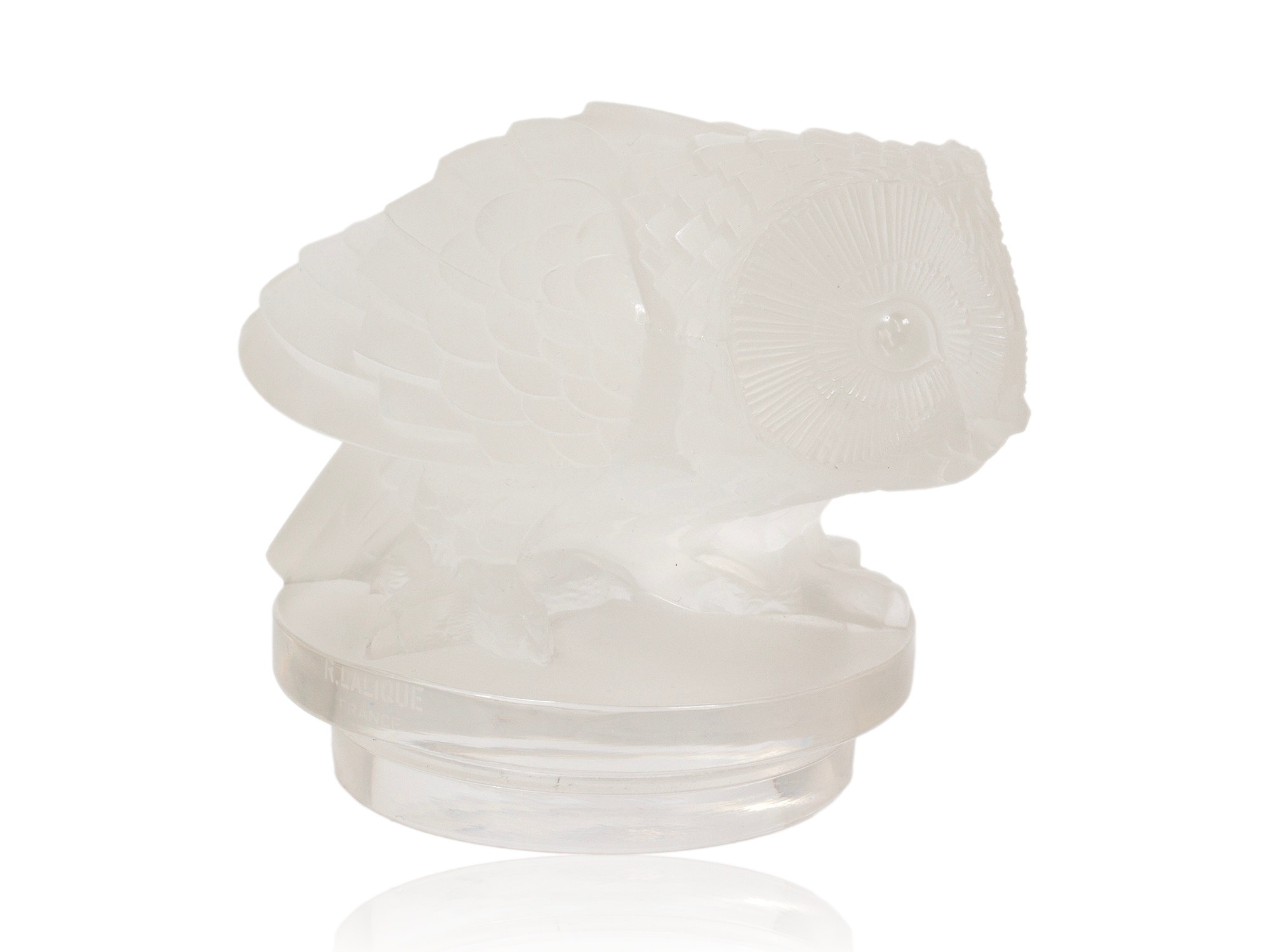
The owl is quizzical and serene, combining charm with rarity. Introduced late in the mascot timeline, it suffered from poor market conditions and was produced in very limited numbers.
The model appeared in the 1932 catalogue and was withdrawn by 1937, continuing as a paperweight.
Signatures are stencilled R. Lalique France.
Renard #1182
Creation date: December 1930 Model number 1182
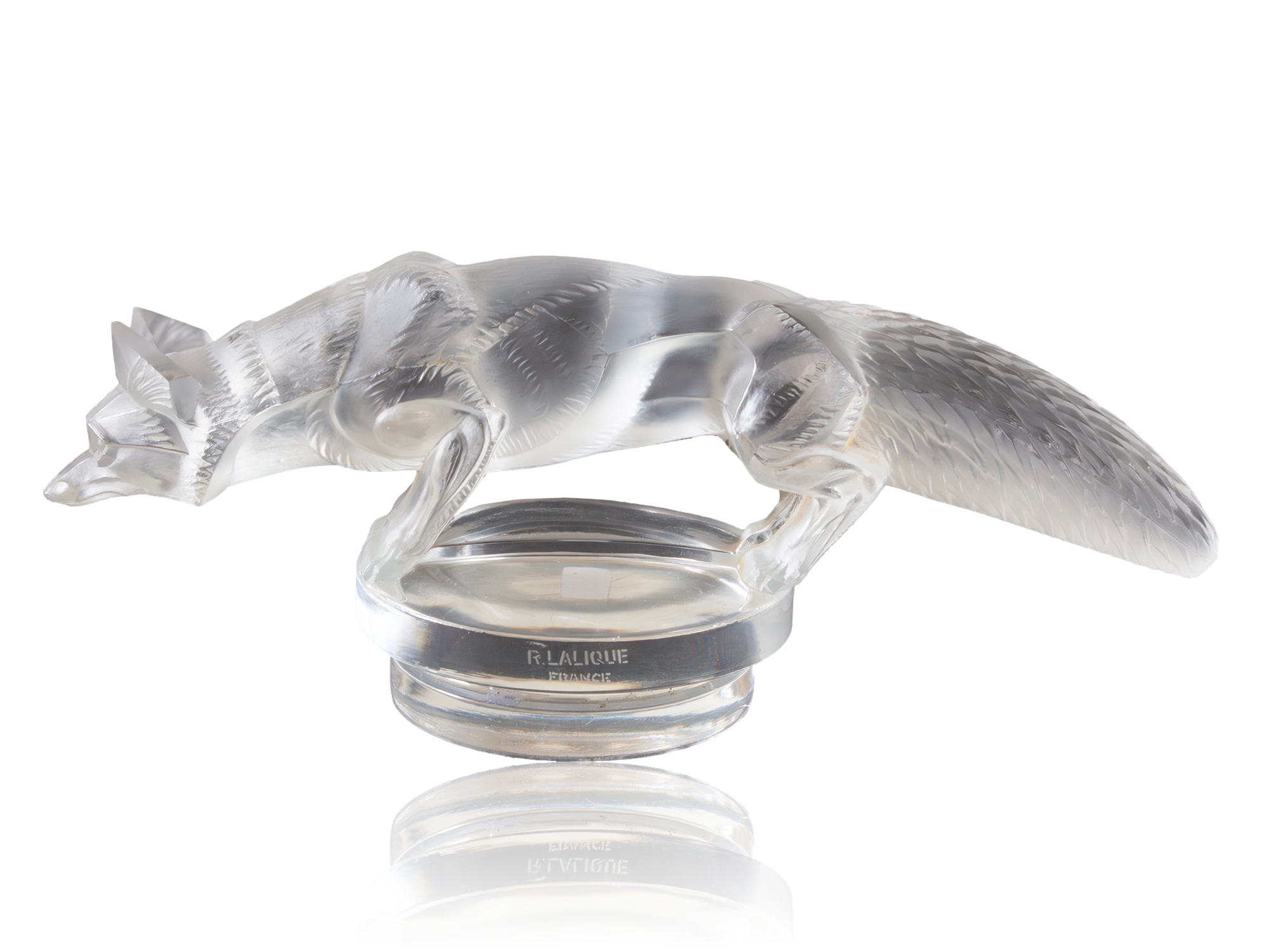
The fox is widely regarded as the rarest Lalique car mascot. Complex and expensive to manufacture, it was a commercial failure at the time but is now the most sought-after model among collectors. Produced in clear glass, with unlisted colour examples noted in literature in Black.
The model appeared in the 1932 catalogue and was withdrawn by 1937, continuing as a paperweight.
Signatures are stencilled R. Lalique France.
Chrysis #1183
Creation date: March 1931 Model number 1183
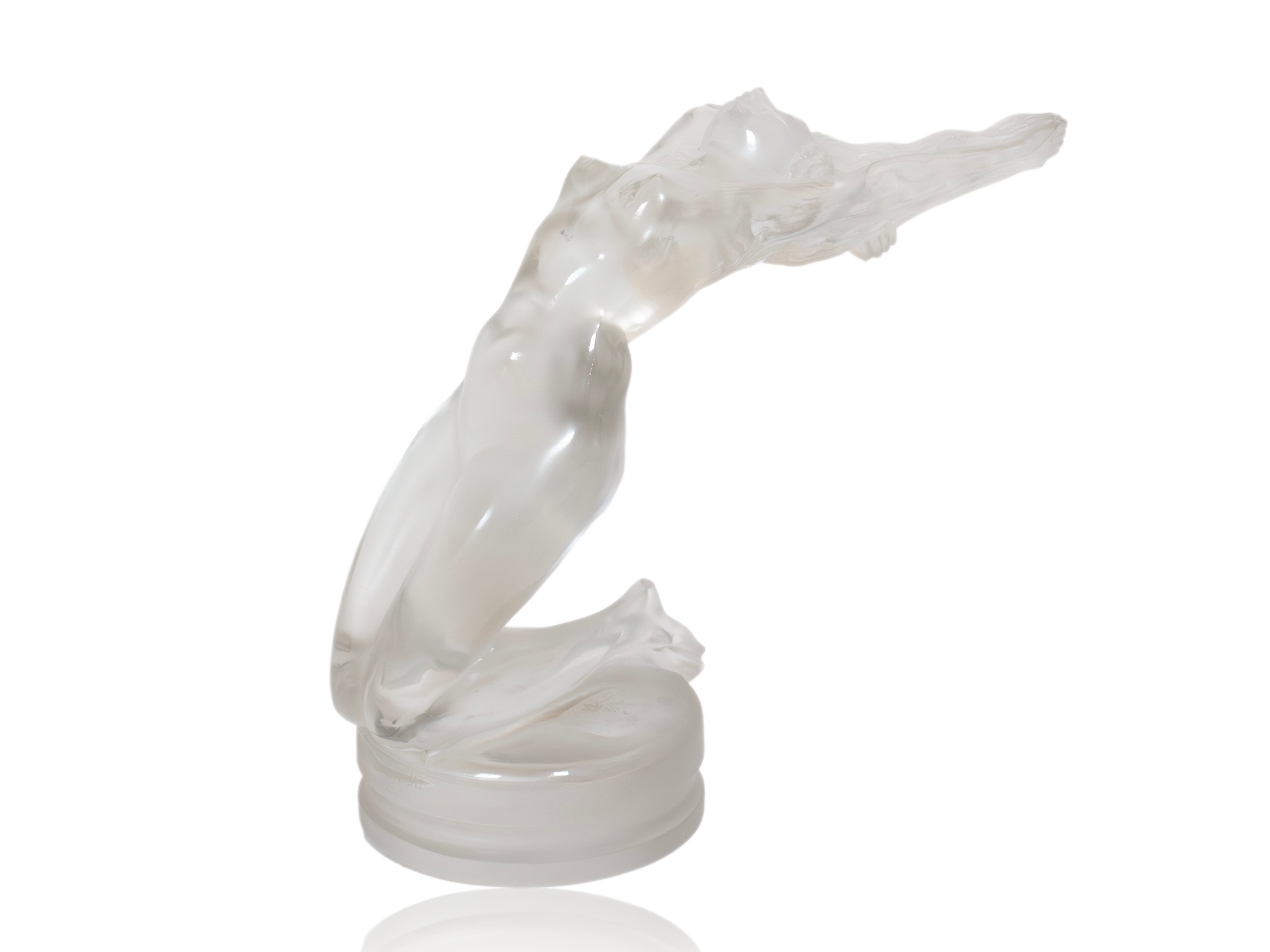
Chrysis represents one of Lalique’s final explorations of the female form as a car mascot. Inspired by Greek mythology, the figure combines sensuality with exoticism and elegance.Produced in clear glass and rare opalescent examples.
The model appeared in the 1932 catalogue and was withdrawn by 1937, continuing in production as a statuette and paperweight for many years. Later crystal reissues exist.
Signatures are stencilled R. Lalique France.
Additional Colours and Uncatalogued Variations
The majority of Lalique car mascots were sold in clear glass, with certain models officially catalogued in opalescent or tinted versions. Over time, some examples have developed an amethyst or purplish hue as a result of prolonged exposure to heat when mounted on a radiator. This colour change was not intentional and did not form part of Lalique’s original marketing, but it is now recognised and valued by collectors.
In addition to these heat-related changes, a very small number of authenticated experimental colour variations are known. These include examples in amber, cherry amber, green and black. Such pieces were never marketed by Lalique and appear to have been produced internally, possibly as trials or limited experiments. Surviving examples are extremely rare, valuable and are often the subject of debate and careful authentication.
Fakes, Copies, and Reissues
During René Lalique’s lifetime, no unauthorised reproductions were produced by his own firm. However, after 1947, official reissues in crystal were made by the Lalique company. These later pieces can be distinguished from original pre-1945 mascots by differences in material, signature style, and base treatment. The later reissues are considerably less valuable and often sold to deceive.
Close period copies were manufactured by other firms, most notably the Persons-Majestic Company in the United States, which produced very similar designs.
Correct identification relies on careful examination of signatures, glass quality, mould characteristics, and provenance. Knowledge of catalogue history and production context is essential when assessing authenticity.
Damage, Condition, and Collector Value
Condition is a critical factor in determining the value of René Lalique car mascots. Chips, polishing, restored damage, and reduction of bases or extremities significantly diminish desirability. Areas of vulnerability include projecting elements, fine edges, and mounting grooves.
Because many mascots were exposed to vibration, heat, and weather when mounted on vehicles, damage is not uncommon. As a result, untouched examples retaining original form and surface are especially prized.
Serious collectors prioritise originality and condition above all else. Specialist handling, experience with multiple examples, and expert knowledge are essential when acquiring original Lalique car mascots, particularly given the complexity of the market and the rarity of undamaged pieces.
Conclusion
René Lalique’s car mascots stand today as some of the most recognisable and sought-after objects of the Art Deco era. Created during a narrow window between technological optimism and economic uncertainty, they capture a moment when craftsmanship, innovation, and design ambition briefly converged. Unlike mass-produced automotive accessories, these mascots were conceived as works of sculpture, each model carefully balanced between symbolism, form, and the physical constraints of glass.
Although exact production numbers are unknown, surviving examples suggest that many models were made in limited quantities, with later designs proving particularly scarce. Over time, a significant number were removed from cars and repurposed as paperweights or bookends, a practice encouraged by Lalique itself once the category was withdrawn. As a result, original mascots intended for radiator mounting and retaining correct period characteristics are increasingly difficult to find.
Today, these pieces are collected across several disciplines. Glass specialists value their technical execution and place within Lalique’s broader body of work. Art Deco collectors recognise their sculptural clarity and period significance. Motoring enthusiasts appreciate them as rare survivors from the golden age of luxury automobiles. Condition, authenticity, and correct identification remain critical factors, particularly given the existence of later Lalique reissues, contemporary copies, and restored examples.
This guide has been assembled to provide clear, accurate, and practical information for collectors and researchers seeking a deeper understanding of René Lalique’s car mascots. For further background on Lalique and his wider output, readers are invited to explore our Makers and Retailers section dedicated to René Lalique. To view original examples currently available, our curated collection of René Lalique car mascots can be found through the links provided alongside each entry.
As interest in Art Deco design and early motoring history continues to grow, Lalique’s mascots remain symbols of a period when even the smallest details of a car were treated as an opportunity for artistry.