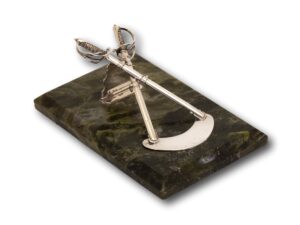
Sampson Mordan & Co
Sampson Mordan (1790-1843) was a London silversmith, inventor, and manufacturer best known as the co-inventor of the first patented mechanical propelling pencil.
He was apprenticed to the engineer and locksmith Joseph Bramah, under whom he gained early exposure to mechanical innovation and precision metalwork.
In 1822, Mordan, working with John Isaac Hawkins, registered the first British patent for a metal pencil with an internal mechanism that advanced the graphite automatically. This invention, later known as the “ever-pointed” pencil, marked a significant advance on earlier lead holders. Mordan later acquired Hawkins’ interest in the patent and entered into partnership with the stationer Gabriel Riddle.
From 1823 to 1837, the firm traded as S. Mordan & G. Riddle, producing silver mechanical pencils marked “SMGR”. Following the dissolution of the partnership, Mordan continued independently as S. Mordan & Co., expanding production beyond pencils to include a wide range of small silver and gold items such as vesta cases, scent bottles, sewing necessaires, sovereign cases, and novelty objects. Mechanical pencils remained central to the business and were produced in both restrained cylindrical forms and more elaborate figural designs.
Mordan entered his first mark as a smallworker at the London Assay Office in 1823. His work is noted for combining mechanical ingenuity with careful decorative design, and many items incorporated secondary functions such as rulers, calendars, or quill cutters.
After Mordan’s death in 1843, the business was continued by his sons Sampson (junior) and Augustus. The firm later took in additional partners and became S. Mordan & Co Ltd in 1898. It remained active into the twentieth century, producing silverware, novelties, and postal scales, and supplying major retailers including Asprey & Sons and Goldsmiths & Silversmiths Company.
S. Mordan & Co exhibited at the Great Exhibition of 1851 and continued trading until 1941, when its factory was destroyed during the London Blitz. Surviving catalogues and hallmarked pieces provide the primary record of the firm’s extensive output.
Showing all 6 resultsSorted by latest