Friedrich Ludwig Hausburg
Friedrich Ludwig Hausburg was a celebrated nineteenth century jeweller and luxury goods maker who became one of Liverpool’s most admired retailers. Born in Berlin in 1817, he began his training in Paris under his uncle August Wilhelm Bernhardt Promoli at 4 Rue de Boulogne. This Parisian workshop specialised in fine jewellery, clocks, and a wide range of fashionable and decorative items, providing Hausburg with a rich foundation in European tastes and techniques.
By the late eighteen thirties Promoli had taken over the business of Thomas Woolfield, a prominent maker and retailer of dressing cases and luxury goods in Liverpool. The shop, once known as Woolfield’s Bazaar, had expanded to occupy four adjoining premises at 71 to 74 Church Street. This connection formed part of Hausburg’s family network, as Woolfield was the uncle by marriage of Hausburg’s wife, Catherine Mossop.
In 1840 both Promoli and Hausburg were naturalised as British citizens. Their naturalisation was remarkable for its speed, completed in only five weeks and signed personally by Queen Victoria. That same year their business adopted the name Promoli and Hausburg and relocated to the Old Post Office Buildings at 24 Church Street. They traded as jewellers and watchmakers and also as makers of desks, dressing cases, lamps, and chandeliers, offering one of the most extensive selections of luxury goods in the city.
By 1841 the business was solely in Hausburg’s ownership. He continued to deal in a broad range of high quality items and developed a reputation for superb craftsmanship. Much of his work displayed French decorative influences drawn from his early years in Paris. While he understood the restrained British taste for elegant but modest exteriors, he often produced pieces with rich and elaborate inlay. His work commonly featured brass, pewter, ivory, abalone, mother of pearl, and tortoiseshell in the style of Boulle. These ornate elements were complemented by interiors lined with finely gold tooled leather, giving his dressing cases and writing boxes a level of refinement rarely equalled in Liverpool.
Hausburg retired in 1860 at the age of forty three, selling his business to W H Tooke who continued trading from the same Church Street address. When Hausburg died in 1886 he left an estate valued at one hundred and eighty thousand pounds, equating to many millions in modern terms, a testament to his success and the high esteem in which his establishment was held.
His shop became something of a legend. A New York journalist visiting in 1849 described the experience in breathless detail, insisting that it surpassed the finest establishments of London and Paris. He wrote that it bore the same relation to the usual bazaars as a costly jewel bears to a trinket of paste, and that it deserved a unique term of its own since neither shop nor store adequately conveyed its splendour or its extraordinary range.
Today, surviving pieces by Friedrich Ludwig Hausburg, particularly his dressing cases and inlaid luxury goods, remain prized for their exceptional materials and their distinctive blend of Parisian influence and British design.
Showing 1–18 of 22 resultsSorted by latest
-


Boulle Sewing Box by Friedrich Ludwig Hausburg
-


Calamander Silver Vanity Box by Hausburg
-
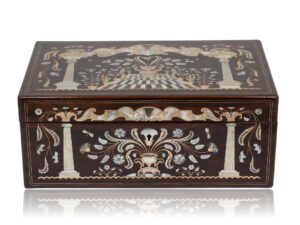

Inlaid Writing Box Hausburg
-
 RESERVED
Antique Jewellery Box by Hausburg
-
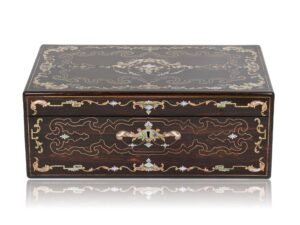 SOLD

Coromandel Inlaid Writing Box Hausburg
-
 SOLD

Writing Box by Friedrich Hausburg in Rosewood
-
 SOLD
Figured Walnut Sewing Box Hausburg
-
 SOLD
Victorian Writing Box Hausburg (Att.)
-
 SOLD

Coromandel and Abalone Sewing Box Hausburg
-
 SOLD
Hausburg Writing Box
-
 SOLD
Hausburg Writing Box
-
 SOLD
Antique Campaign Writing Box
-
 SOLD
Jewellery Box in Rosewood by Hausburg
-
 SOLD
Antique Hausburg Burr Walnut Jewellery Box
-
 SOLD
Antique Calamander Jewellery Box
-
 SOLD
Papier Mache Sewing Box
-
 SOLD

Antique Writing Box by Hausburg
-
 SOLD
Antique Hausburg Writing Box