Calamander
Calamander is a highly decorative variegated ebony most closely associated with the species Diospyros quaesita, which is endemic to Sri Lanka. It belongs to a small group of striped ebonies within the Diospyros genus and is closely related to woods commonly referred to as Coromandel and Macassar ebony. Historically these names were often used interchangeably due to their visual similarity and shared characteristics.
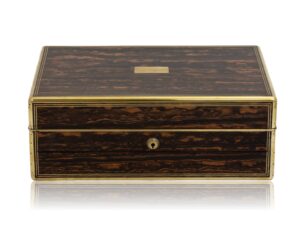
The wood is immediately recognisable by its dramatic contrast of hazel brown ground colour crossed with bold black striping. The figure is typically strong and consistent, producing a striking linear appearance that polishes to a deep natural lustre. Calamander is exceptionally dense and close grained, giving it both visual refinement and excellent durability.
Because of its beauty and strength, calamander was widely used during the eighteenth and nineteenth centuries for high quality furniture, fine veneered objects, and luxury domestic pieces. It was particularly favoured for use as veneer, where its bold striping could be book matched to create symmetrical patterns. It also found use in cabinetry, instrument making, and decorative detailing.
Extensive historical logging severely reduced natural populations of Diospyros quaesita, and the species is now considered vulnerable. As a result, original calamander timber is no longer commercially available, and surviving antique examples are especially prized. The rarity of the wood, combined with its distinctive appearance, makes calamander one of the most desirable exotic timbers encountered in fine antique objects.
Showing all 17 resultsSorted by latest
-


Tantalus by George Betjemann in Calamander
-


Calamander Silver Vanity Box by Hausburg
-
 SOLD

Victorian Calamander Jewellery Box by H. Mitchell
-
 SOLD

Calamander and Silver Tantalus by Betjemann
-
 SOLD

Jewellery Box by Charles Asprey
-
 SOLD

Asprey Jewellery Box in Calamander
-
 SOLD

Unusual Antique Calamander Jewellery Box
-
 SOLD

Antique Calamander Jewellery Box Lund
-
 SOLD
Georgian Calamander Jewellery Box
-
 SOLD

Victorian Calamander Jewellery Box
-
SOLD
Coromandel Jewellery Box
-
 SOLD

Calamander Silver Vanity Box
-
 SOLD
Antique Calamander & Satinwood Games Drinks Cabinet
-
 SOLD

Antique Sewing Box by Lund
-
 SOLD
Alfred Dunhill Cigar Box
-
 SOLD
Antique Calamander Jewellery Box
-
 SOLD
Edwards Vanity Box